
EquipmentShare: “A Shell Game” – How Ponzi-Esque Accounting Hides Failing Branches at America’s Fastest-Growing Rental Company
Published on October 7, 2026

“At some point in my career there, we would literally sit around the table … with other guys in my role, and we would literally talk amongst ourselves and try to figure out if this was the world’s largest Ponzi scheme that we had ever seen. You know? … Are we in one of these Ponzi Pyramid scheme type things where all of a sudden this is just going to blow up in our face?” – EquipmentShare Former District Manager
“Personally, I just think it’s all cooked numbers. I don’t, I don’t see any great margins.” – EquipmentShare Former District Manager
“When you’re opening new stores, you can hide a lot of cost in that. I mean, all kinds of costs in that new store. So, so that’s why you’ll see in that first year… there’s massive losses in those new stores… they’re hiding costs and juicing the stores, the mature stores.” – EquipmentShare Former Regional Manager
“They would never really give the branches their financials, and if they did, it was a made-up version…They did not want to share a lot of that information. It was, again, I remember a lot of the branch managers that I interacted with were very frustrated because they could never see their earnings… the biggest thing I’ve heard the entire time was it’s a pyramid scam across the board.” – EquipmentShare Former Finance Manager
“Um, yeah, I mean, like, that, that bullshit that they came out with, uh, when they dropped their 2025 earnings — I mean, if my math maths correctly, I don’t know, my math and their math never, never mathed.” – EquipmentShare Former District Manager
Introduction
On June 24, 2026, we exposed rampant self-dealing and questionable capital raising around EquipmentShare’s (“EQPT”; “the Company”) off-balance-sheet fleet program (“the OWN Program”; “OWN”), along with other glaring governance lapses; another short-focused group has since added findings of its own. That was just the tip of the iceberg. Today we bring fresh evidence that, in our opinion, makes EQPT’s reported financials wholly unreliable.
Our ongoing investigation now spans 32 interviews with 23 former employees and industry experts, many of whom ran EQPT’s branches and managed their P&Ls, plus the Company’s own branch-level disclosures, 141,000+ scraped used equipment listings, and public records.
EQPT promotes a ramp to “industry-leading” 55% mature-site margins, but branch operators covering a substantial part of its network attribute its results to a “shell game” and a “pyramid scheme” in which revenues and costs are shuffled between branches. One called this “the Netflix documentary part” of a broader pattern of accounting chicanery, including manipulated bad debt and multiple sets of books kept by management to “cook” key metrics and bury the grim state of the business. By these strikingly consistent accounts, most of EQPT’s branches hemorrhage money.
The Company’s response to critics has been all optics, no substance. Material we cited appears to have been stealth-edited and deleted (see Appendix I). Meanwhile, EQPT has raised full-year guidance and deflected investors to boilerplate related-party disclosures on its website. Most recently, it sought to reassure the market that its “financial statements are independently audited by a Big 4 accounting firm.” Wirecard (EY), Silicon Valley Bank (KPMG) and Enron (Arthur Andersen) had top-tier auditors too.
Founders Jabbok and Willy Schlacks have bought stock on the open market, less than 1% of their combined holdings. As another short-focused group noted, those buys were likely margin-call protection, with 10.2 million of the Schlacks’ respective Class B shares pledged as of the most recent disclosure [Pg.30].
Umibōzu Research’s Core Opinions
- We believe EQPT manipulates its reported financials to tell the story of a branch network ramping to “industry-leading margins.” It apparently puts lipstick on a pig by jettisoning operating expenses (payroll, maintenance, hauling, etc.) from older sites to <12-month branches. Our analysis indicates these costs smother openings and are the real explanation for industry-unique first-year losses at EQPT’s branches.
- We think “New Market Startup Costs” are a ruse – a metric concocted to fool investors into ignoring first-year losses and obscure how EQPT’s prized mature-site (>2-year) margins are engineered. Industry experts told us these costs should be de minimis, yet they have ballooned to $3.5 million per branch at EQPT (40% above its own guide).
- Investors appear to have taken EQPT’s maturation story on faith. But overwhelming testimony from former employees that the Company’s branches bleed money convinces us that it is unlikely to run a profitable rental network at any scale. EQPT looks like WeWork – a lousy operator that hypes a supposedly novel business model in an ancient industry and uses inappropriate add-backs (New Market Startup Costs and OWN payouts) to justify being evaluated on non-standard metrics (e.g., “Adjusted Core EBITDA”). After removing them, “Adjusted Core EBITDA” for the trailing-twelve-months (TTM) period ended June 2026 would fall 57%.
- We don’t buy management’s spiel that EQPT can run on more fleet than peers. Formers flag tons of “junk” and “hard-down” (broken) equipment that gets passed around branches like a “hot potato.” We scraped its used equipment listings, and uncovered 141,000 pieces up for sale, including 15,562 from the 2026 model year, at asking prices equal to $3.5 billion, 36% of its total Original Equipment Cost (“OEC”).
Summary
- Management brazenly promotes a “growth algorithm” distinct from its rental peers: branches open with deep losses, then follow a predictable ramp to “industry-leading margins,” lifting overall profitability as the mix skews toward mature sites. People who ran EQPT’s branches tell a night-and-day different story.
- One former District Manager shared “only 92 of 388 locations were profitable after the IPO,” recalling internal P&L meetings were “consistently a bloodbath.”
- A former Regional Manager pegged profitability at 15 to 20% of the ~50 sites they covered. Another with >30 locations put their 13 mature sites at <$1 million of quarterly profit, with almost half that generated by two locations. One plainly labeled the 55% mature-site EBITDA margins a “bold-faced lie at best.”
- These veterans say losses at EQPT are unprecedented. In the words of another former District Manager: “I’ve been in the equipment rental industry since 1997, and I have never witnessed anything like it.”
- While EQPT paints a highly choreographed waltz to “strong organic unit economics,” it looks more like musical chairs to us. Formers recount huge costs shifted from mature sites onto new branches to manufacture the 55% EBITDA margins, a scheme that relies upon a constant flow of openings and that sources likened to a Ponzi.
- A former District Manager said it was “easy for me to move costs to a new market,” with EQPT’s mature branches dumping “hard-down” (broken) and “junk” equipment onto openings. A branch leader in a different market explained the receiving units were then left to “do the repairs and incur the cost, which is why the newer branches were losing … $500,000, $600,000 a month.”
- It’s normal for rental companies to shift some latent capacity to new sites, but formers describe unrentable “garbage”, and the costs that come with it, systematically moved to openings to flatter mature-site margins.
- Formers quantified broken equipment at anywhere from >20% of a district’s fleet to >80% of a new branch’s starting gear, with one stating they had “more broke [equipment] than we got to rent.”
- One former District Manager put the equipment moved in a single market at “tens of millions of dollars of OEC.” Another said from shuffling alone “each branch spends a hundred to two hundred thousand a month on outside hauler fees.”
- The games appear to run on the revenue side too. Witnesses claim contracts would be fulfilled out of one branch while revenue was booked at another, steering sales onto the books of whichever site needed to “look profitable on paper” while its costs went the other way.
- “When we get to month 13, we’re going to move all that gear to the newest cost center and then we’re going to start writing contracts out of one cost center but pushing the revenue to another cost center and we’re going to do whatever we need to do to make it look profitable on paper.” – EquipmentShare Former District Manager
- Termed a “shell game” by multiple sources, the scheme exploits EQPT’s own policy of judging branches on revenue alone in their first 12 months. Former employees called the window “immunity” and “free rein,” ending abruptly on “day 366.” This incentivizes mature branches to pass the trash, while new openings, in theory, have no reason to object.
- We reviewed EQPT’s cohort disclosures, spanning 18 months from 4Q24 to 2Q26. Over that window, 96 subscale branches graduated into the mature cohort (123 to 219, up 78%) and dragged revenue per branch down 18%, from $12.0 million to $9.8 million. Operating leverage suggests margins should have followed revenue down. Instead, they stayed pinned at 54 to 55% throughout. We believe the drivers of these margins show signs of accounting trickery, undercutting EQPT’s ramp narrative.
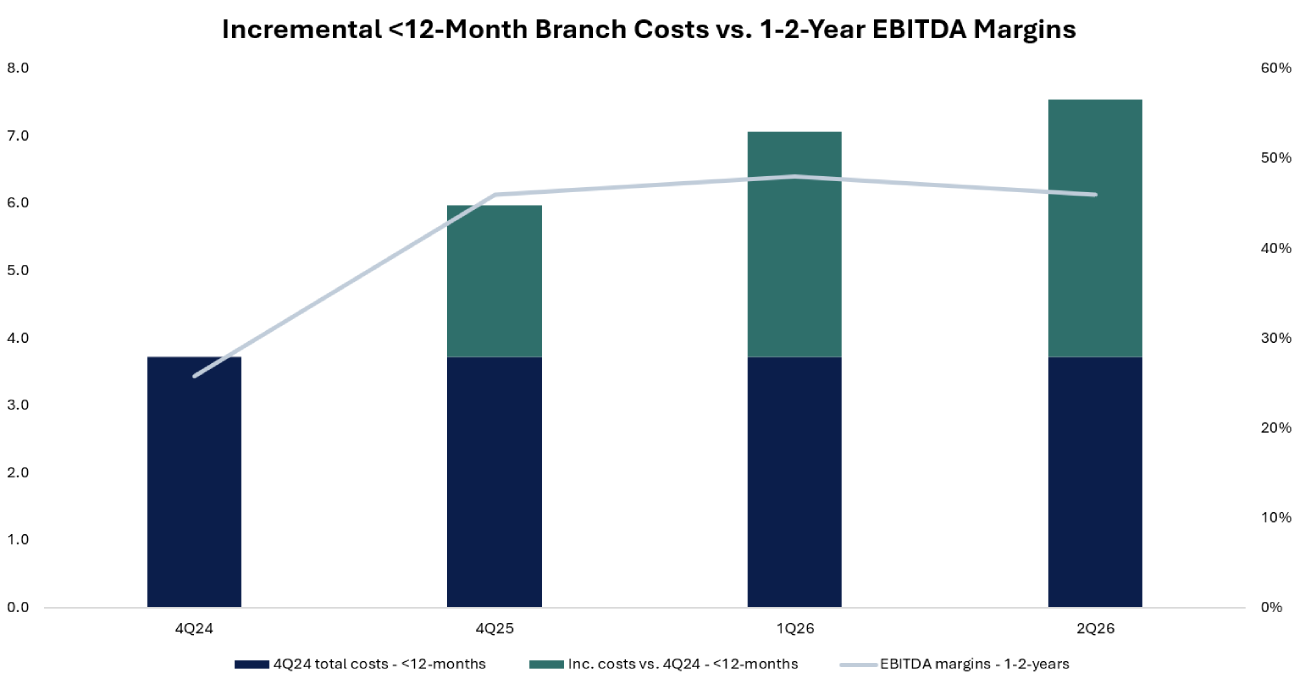
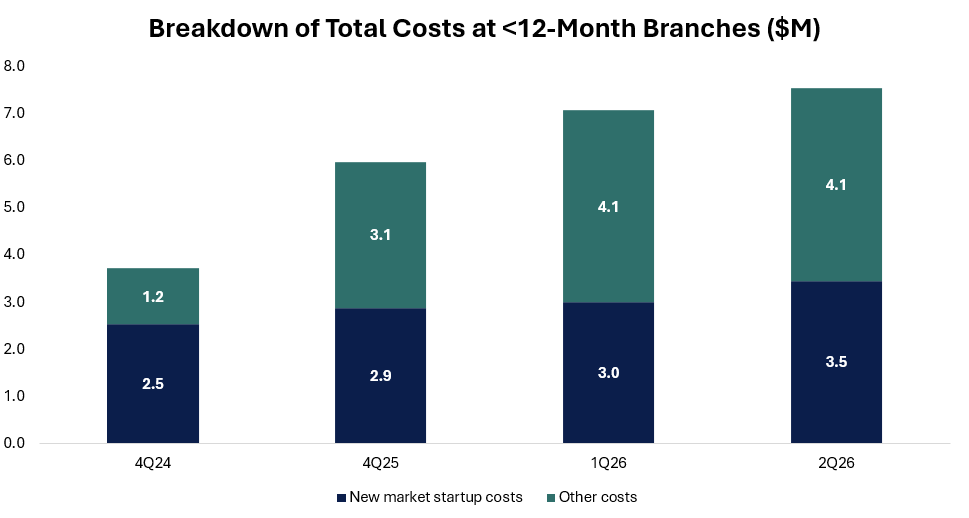
- We believe our analysis of EQPT’s implied cost data further corroborates the accounts of former employees. Over the 18-month period, total costs at <12-month branches doubled, from $3.7 million to $7.5 million per branch, while costs per mature site fell 19%, from $5.4 million to $4.4 million, preserving the illusion of its mature-site margins. Throughout, EQPT’s youngest branches carried $2.2 million (50%) higher cost than mature ones, $6.5 million against $4.3 million (medians), on a fraction of the revenue. As of 2Q26, a first-year branch costs 71% more than a mature one and 134% more than a 1-2-year branch.
- The inexplicably high costs at <12-month branches appear to drive EQPT’s first-year losses. The Company says it bears these costs because it grows organically while peers expand through M&A. We aren’t buying it. Peers running their own aggressive greenfield and cold-start campaigns open branches profitably and climb gently from there, and we can’t find any disclosures for a metric that measures the cost of opening them, let alone an add-back.
- Sunbelt opened ~400 branches in its “Sunbelt 3.0”, 231 of them greenfields. They provided a ramp curve with 0-2-year sites at 41% margins, double the 20% median EQPT’s identically aged branches recorded over our 18-month analysis window.
- The inexplicably high costs at <12-month branches appear to drive EQPT’s first-year losses. The Company says it bears these costs because it grows organically while peers expand through M&A. We aren’t buying it. Peers running their own aggressive greenfield and cold-start campaigns open branches profitably and climb gently from there, and we can’t find any disclosures for a metric that measures the cost of opening them, let alone an add-back.
- In our view, EQPT conjured an original metric –“New Market Startup Costs” – to excuse its unique first-year losses and conceal some of the costs shifted away from mature sites. The bucket is vaguely defined across filings and includes whatever management wants it to according to credit documents.
- Operators we spoke with said there are minimal non-recurring costs to open branches that run through the P&L. A former CFO of a leading rental peer told us the investment is “all capital” and “there’s not a lot of EBITDA costs in terms of starting up a branch.”
- “There’s nothing that is truly a unique startup cost where you’ve got to do something that is a one-time fee… maybe you got turning the power on, I mean, but it’s minimal dollars. I mean, you’re not talking hundreds of thousands of dollars here.” – EquipmentShare Former Regional Manager
- “It’s that sort of walnut game, right? You’re just sort of moving bits and pieces around and trying to highlight a margin dig that’s probably institutional rather than due to startup costs.” – Former CFO of a Leading Rental Company
- Operators we spoke with said there are minimal non-recurring costs to open branches that run through the P&L. A former CFO of a leading rental peer told us the investment is “all capital” and “there’s not a lot of EBITDA costs in terms of starting up a branch.”
- Former branch operators scoffed at EQPT’s internal controls. Monthly P&Ls that peers close within days took “30, 45 days” to reach branches, and costs showed up on their books with no justification. They cited nondescript corporate charges and invoices from prior years.
- We were told that the system for moving fleet between branches has “no checks and balances” and could be readily abused.
- “So, you can just click on whatever one you want. It doesn’t notify anybody. No emails go out, no notifications. Nobody has to receive it. It just now belongs to whatever branch you click on.” – EquipmentShare Former Branch Manager
- “I started looking at P&Ls and I’m like, hey, what is this line? You know, what is this line item?” – EquipmentShare Former Regional Manager
- “It’d be from previous years, like invoices from 2024 showing up on 2025, like June P&L for $4,500 for an outside hauler bill or some random marketing fee or something like that that would just come out of nowhere and there’s no explanation for it.” – EquipmentShare Former District Manager
- We were told that the system for moving fleet between branches has “no checks and balances” and could be readily abused.
- These financial shenanigans sync with broader allegations raised to us about EQPT’s accounting, including that, at times, it kept more than one set of books.
- Former finance department and branch-level personnel shed light upon manipulated bad debt, recycled expenses, and different rollups visible in the Company’s internal tables. By their account, six consecutive audits failed to close on normal timelines, and a firm hired to assess IPO readiness was pulled off the engagement by EQPT after questioning its credit and collections practices.
- One former finance employee also described corporate credit card fraud they understood to total ~$30 million over five years, reported up the chain and, by their account, ignored.
- “They never sent auditors out… Who knows the level of wrongdoing, all these branches… I think it was like $30 million, give or take, over, I think, a 5-year period of time… But it was millions of dollars of fraud.” – EquipmentShare Former Finance Manager
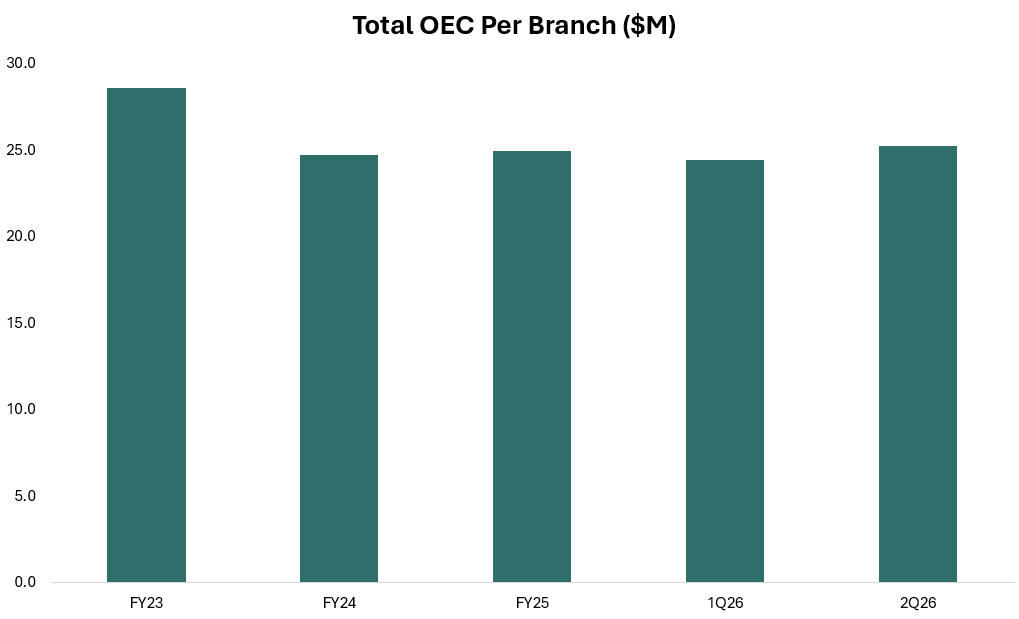
- The games at EQPT’s branches can be traced back to OWN, which incentivizes excessive fleet accumulation. Since the end of 2023 EQPT has grown OEC 82% to $9.9 billion, 83% of it through OWN, and now carries $25 to 30 million of fleet per branch, roughly double United Rentals. The glut has cratered utilization, a key industry metric EQPT does not report. Formers said that metric wasn’t even regularly shared internally, and when it was, it was a “made-up version.”
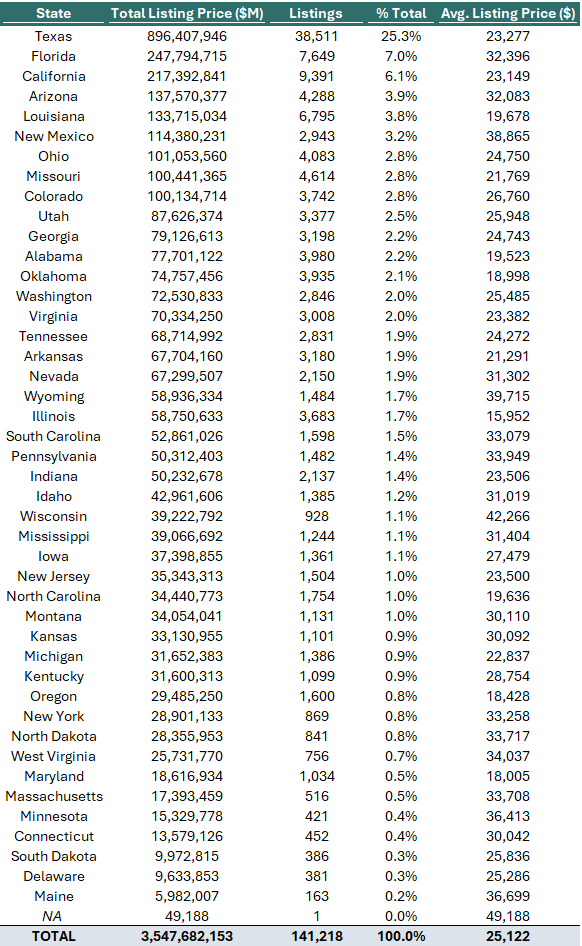
- We found 141,218 pieces of EQPT’s fleet listed for sale at $3.5 billion of asking prices, 36% of its OEC, across 353 locations. Formers explained that, unlike other rental companies, EQPT lists much of its fleet for sale while it is still out on rent. We believe the catalog is either a symptom of EQPT’s excessive fleet accumulation, or the Company is warehousing fleet on its own balance sheet until it can find an OWN investor to take it, potentially making the Company far less “capital-light” than advertised.
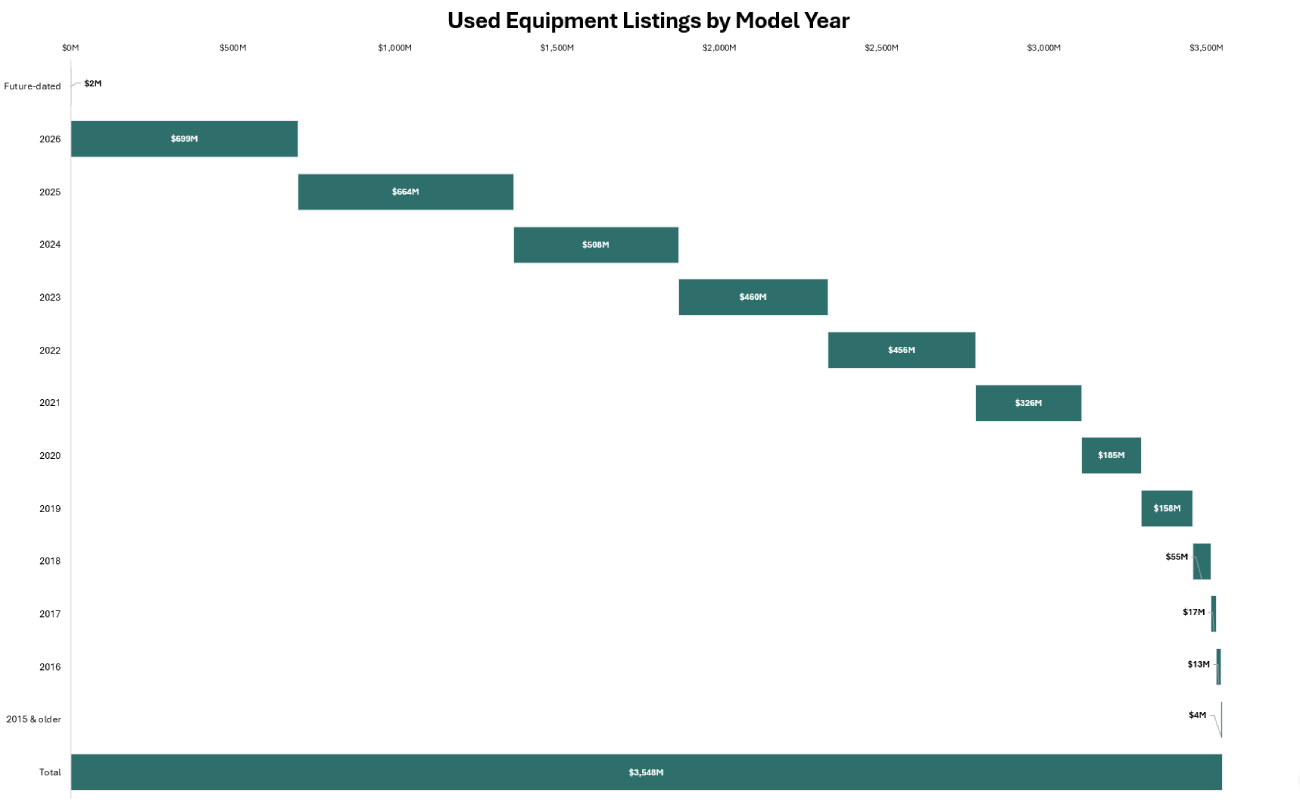
- 88% of EQPT’s listings are five years old or younger and $700 million are 2026 models. It has 27% more aerial lifts for sale than United Rentals, whose fleet is twice the size, and 2.5x as many as Herc.
- We found EQPT selling hundreds of millions of dollars of gear, including current-year equipment, at markets where it is supposedly expanding, yards near megaprojects, and from branches that don’t appear to be open yet.
- “If it’s selling anything that’s less than five years old, then that’s a real red flag.” – Former CFO of a Leading Rental Company
- “Either you’re completely bloated and overfleeted, and you have to defleet, or there’s something else going on in the background.” – EquipmentShare Former District Manager
- Formers cautioned that EQPT’s aggressive expansion risks compounding the problem due to cannibalization and undisciplined site selection. They said the Company “rubber-stamped” a generic fleet plan across geographies, while highlighting rookie mistakes like not grasping that “the same dozer doesn’t work in Florida as it does in Montana” or that “not every place is Texas.”
- We believe EQPT has been buying time by opening new branches but as formers warned eventually the scheme will hit a wall. As of June 2026, the ratio of mature branches to openings has climbed to 3.3x from 1.6x just 18 months earlier and would reach 6.7x even if EQPT grows to 800 sites by 2030.
- “What you guys read as investors, and they’ll tell you, well, you know, we had associated costs with these stores, blah, blah, blah, blah, blah. But you look at our older stores, they’re performing well. Well, the numbers, yes, they are performing better. I wouldn’t say they’re performing well. And I would also say that, you know, you’re kind of, you know, you’re kind of, in my, my own perspective, you know, really manipulating what is truly happening with what would normally be a new store, and you’re just, you’re just kicking the can down the road because eventually you got to solve the problem. But if you keep opening up more and moving the problem around, I guess you’re just buying more and more time, which is essentially what they’ve been doing.” – EquipmentShare Former Operations Executive
Bull Case: A Differentiated Branch Network With Some Hair On It – “Industry-Leading” 55% Mature-Site EBITDA Margins Are Too Good To Pass Up
Some investors remain optimistic about EQPT amidst the allegations. They grant that the related parties and off-balance-sheet financing look suspect but argue the unit economics are too good to pass up, and that behind all the smoke, EQPT may have figured out something peers haven’t.
The story now hinges upon the best-in-class unit economics management attributes to its unique organic growth strategy. This is the basis for EQPT’s goal of >700 branches with >$21 billion of OEC by 2030, and long-term targets set for 57%+ mature-site EBITDA margins and NOPAT margins of 29% – figures extrapolated from just 59 sites with 4+ years of operating history at FY24 (see footnote on slide), ~15% of today’s 391 branches.
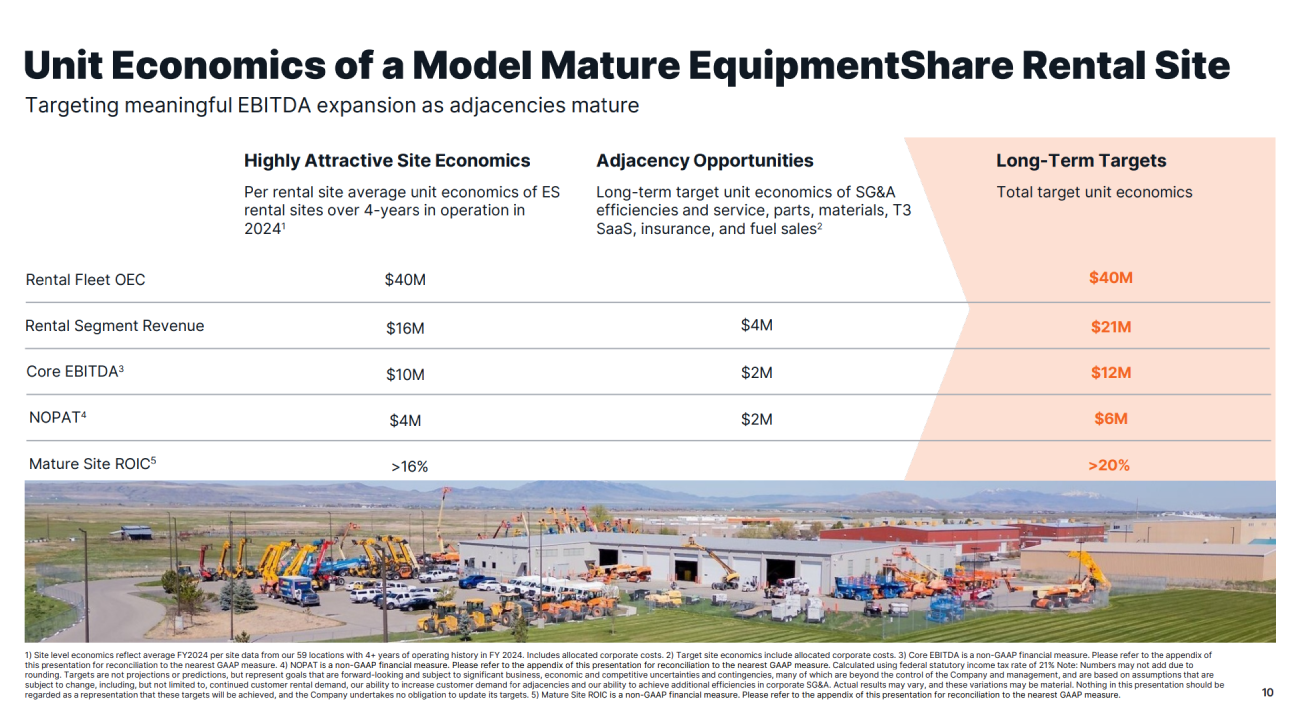
Source: Q2 2026 Investor Presentation [Pg. 10]
Bulls forgive EQPT’s current financials as a mix problem. With 44% of the network <2-years-old, the consolidated 43% margin is dragged down by new branches; as those sites age and density builds, they are supposed to converge on the 55% the mature cohort already reports. At 700 branches, the math turns seductive: hold today’s $5.4 million of EBITDA per mature branch flat and the network would generate ~$3.8 billion, nearly 3x today’s level on the same basis.
CEO Jabbok Schlacks has promoted [1,2] that EQPT is at an inflection point, with the mix shifting toward mature sites, unlocking the embedded earnings power of the business.
“We now have 186 mature sites and 166 growth sites that is under 24 months old, which we believe provide a compelling case for embedded earnings growth potential in the coming years.” – EquipmentShare CEO Jabbok Schlacks – 4Q25 Earnings Call (March 19, 2026)
“And what’s interesting, if you look at us, and I think we’ve talked about it before, we’re at that over midpoint where there’s more mature stores actually producing revenue and producing the associated EBITDA and earnings than there are actually stores that we’re opening.” – EquipmentShare CEO Jabbok Schlacks – 1Q26 Earnings Call (May 14, 2026)

Source: Umibōzu Meme Department
Divergence from industry peers has been the “tell” at a long list of corporate collapses. Wirecard’s too-good-to-be-true margins, Luckin Coffee’s extraordinary per-store economics and WeWork’s location-level ramp and “Community Adjusted EBITDA” were all one-of-a-kind and charmed investors.
EQPT’s branches don’t appear to ramp like anyone else’s. Peers say branches open on below-average margins, scale into their cost base and gradually drift toward parity with mature units. EQPT’s, by contrast, incur deep year-one losses we could not find anywhere else in the industry, then swing violently to 55%.
The #1 player, United Rentals (NYSE: URI), opened 72 cold starts in 2024 and 60 in 2025, and while those units skew to specialty and may be cheaper to open, it reports no startup costs at all and characterizes openings as a “marginal drag.” Herc Rentals (NYSE: HRI), the third-largest operator, has opened ~80 greenfields (units stood up from scratch) since late 2020 and says they “take about 24 to 36 months to get fully accretive to our branch operating margin,” with no mention of losses. Its 2021 investor deck [Pg. 20] put branch EBITDA margins in “developing” markets at ~35 to 45%, rising to 45 to 55% “maturing” and 55 to 65% “scaled.”
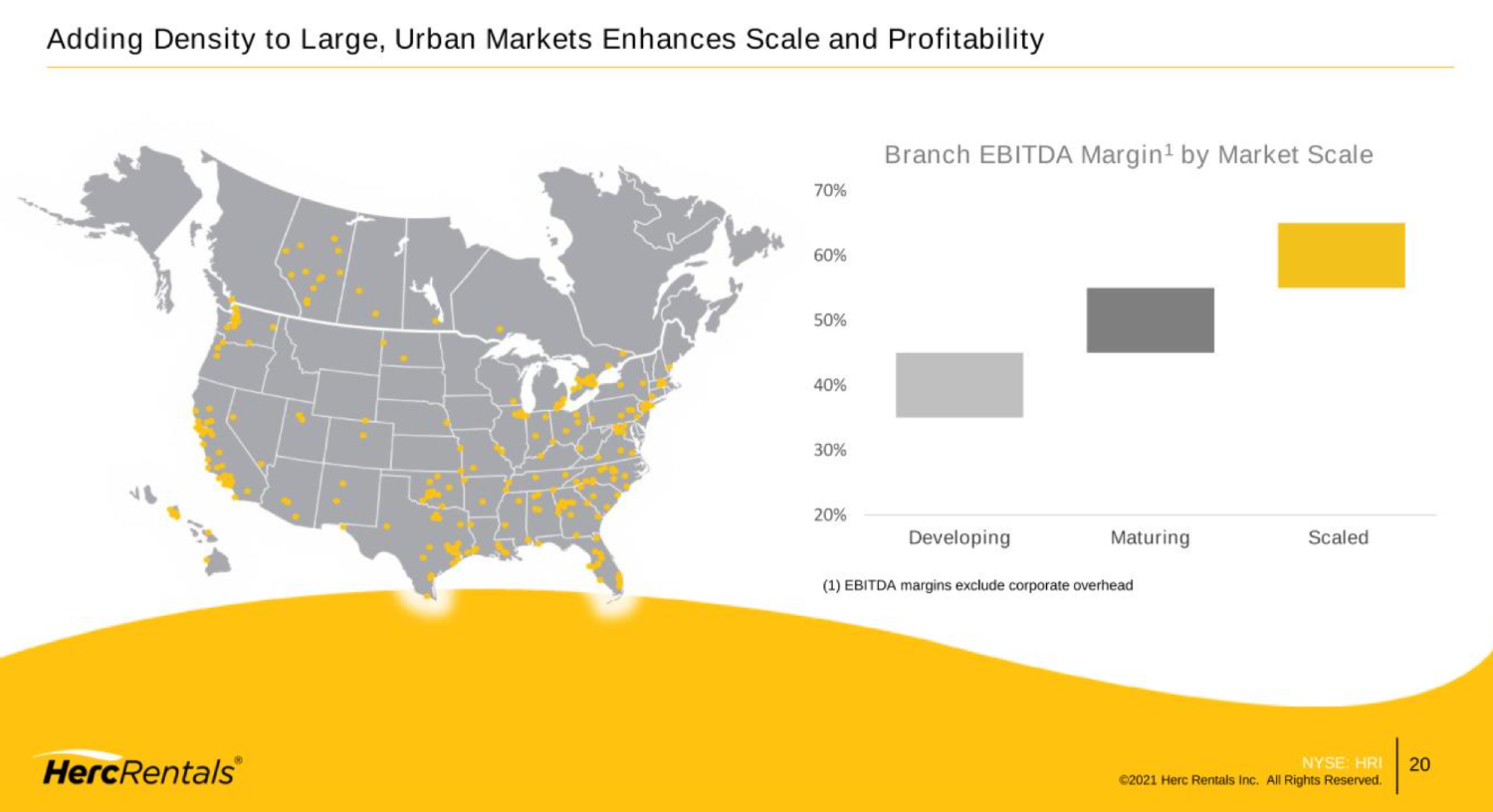
Source: Herc 2021 Investor Presentation
The cleanest comparison comes from the industry’s #2, Sunbelt Rentals (NYSE: SUNB). At its 2024 Capital Markets Day [Pg. 50], having added ~400 locations under its “3.0” plan, Sunbelt showed how its greenfields ramp: ~41% EBITDA margins in years 0-2, ~53% in years 2-5 and plateauing at ~56% only after year 5 (For further data, see Appendix II).
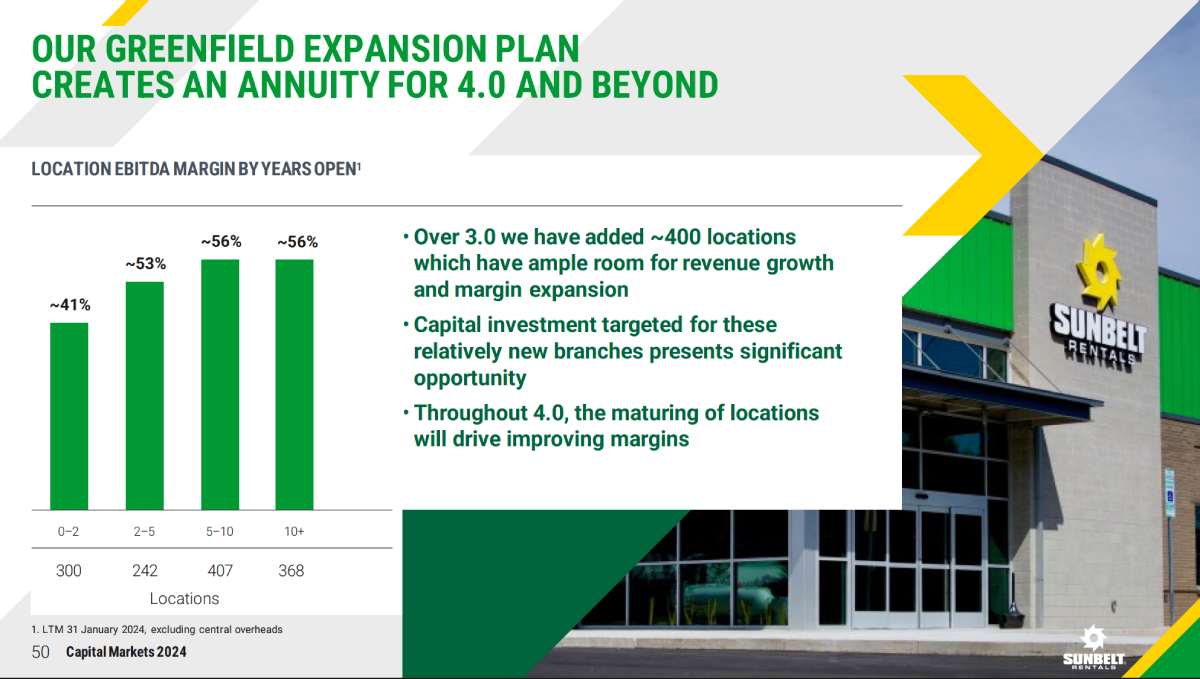
Source: Sunbelt (Ashtead) 2024 Capital Markets Day
Regroup EQPT’s cohorts into the same 0-2-year bucket and its branches earned EBITDA margins of 18% to 21% in each of the last three disclosures, roughly half of Sunbelt’s ~41%. After their second year, EQPT says they leap to 55%, above the ~53% Sunbelt shows for sites two to five years old.
On paper, EQPT’s branches end up at, or even above, peer margins. But we believe both the road to these vaunted margins and the destination itself are a fantasy built through accounting games. As we will show, the problem isn’t just how EQPT’s sites ramp relative to peers: its own former branch operators describe an operating reality completely detached from these figures.
EquipmentShare’s Mature-Site Margins are “A Bold-Faced Lie at Best”; Branch Leaders with Direct Access to Financials Vividly Describe the Network as “a Bloodbath” – Just 92 of 388 Sites Profitable After IPO
After our first report, a former District Manager reached out to us, sharing that the Company’s internal meetings showed just 92 of its 388 locations profitable after the IPO.
“After the IPO, the company’s focus appeared to shift from generating profit to opening as many branches as possible, as quickly as possible. I participated in the monthly earnings meetings, and the results were consistently a bloodbath. Only 92 of the company’s 388 locations were profitable, yet new branches continued to open every month.” – EquipmentShare Former District Manager
The former told us they, along with other District and Regional Level Managers and EQPT’s VP of Sales, had monthly meetings that provided direct access to all branch financials.
Interviewer: “When you mentioned that most the branches are unprofitable… Just curious, where did that data come from?”
EquipmentShare Former District Manager: “We also had a monthly earnings call with all District Managers, Regional Manager and VP of Sales [REDACTED] to review what was needed at all the locations. We had access to all the branch financials during these meetings.“
We sought out formers that held these exact roles across numerous markets – the very people we learned EQPT tasks with branch financials. To preserve our sources’ anonymity we have removed identifying pieces of information from quotes and reduced the specificity of their titles. Our interviews provided the most consistent testimony we have gathered on a company: most branches lose money.
A former District Manager stated bluntly that EQPT’s figures are “all cooked numbers,” sharing even the best location in their coverage, a site generating $1 million per month in revenue, barely turned a profit.
“Personally, I just think it’s all cooked numbers. I don’t, I don’t see any great margins. I mean, even my best location that was a million-dollar-a-month We were barely – according to them, we were barely making a profit, and we couldn’t run any thinner than we ran.” – EquipmentShare Former District Manager
The view from one rung up was no better. A former Regional Manager with oversight of roughly 45-50 units put profitability at 15-20% of stores.
Interviewer: “How many of those were profitable?”
EquipmentShare Former Regional Manager: “15 to 20%, maybe.”
In a different market, a former District Manager said that in the worst months just two of the several branches they ran were profitable. They described real-time internal forecasting that showed sites making money right up to month-end, only for the P&Ls corporate released to come in far lower, or in the red.
Interviewer: “How many were profitable?”
EquipmentShare Former District Manager: “In the best months, probably five of them, six of them. Worst months, probably two. Look, I had some really, really good store managers. I had a lot of experience in my area. The numbers that I would look at, and I would review during the month should have been 100% profitable. They’ve got a system where they can forecast your P&Ls so it’s kind of real-time. You’d go into the end of the month showing the branch profiting $100,000 a month and then the P&Ls would come out, and it’s only showing 40. Or you’d have one showing that you were going to be profitable in the third month up until the last day of the month and then they would release the P&Ls, and you’d be showing a loss.“
We clarified the age of these stores. They told us they were all mature, and if anything, the problem ran the other way where branches were pushed to grow until they “bust at the seams.”
Interviewer: “If that’s the case, amongst those, were those all generally mature stores?”
EquipmentShare Former District Manager: “Yes. All of those stores were all mature stores. That was one of the fights that I had there is our store, particularly in [LOCATION]. They would buy these stores based on immediate need and then they would want you to grow these stores. Well, eventually the stores would bust at the seams.”
Many of our sources were industry veterans with decades of experience. They consistently described branch losses unlike anything in their careers and an overall broken operating environment. As one former District Manager put it:
“Some rental locations in [STATE] were reportedly losing $500,000 to $600,000 per month. I’ve been in the equipment rental industry since 1997, and I have never witnessed anything like it.” – EquipmentShare Former District Manager
We asked where our witnesses thought EQPT’s mature-site EBITDA margins really sat, and the answers were never anywhere near 55%. The former District Manager who called the numbers “cooked” stated point-blank that 55% was a “bold-faced lie at its best”, wouldn’t put the real figure at even 15%, and had no idea how EQPT made money “other than moving the money around.”
EquipmentShare Former District Manager: “Not true. I can promise you that.”
Interviewer: “Just not true?”
EquipmentShare Former District Manager: “No, no, that’s a bold-faced lie at its best.”
Interviewer: “I mean, what would you peg the real margins of this business at on an EBITDA basis if you could? I know it’s a guess because it’s probably, if they say they’re 55, I guess, what are you thinking?”
EquipmentShare Former District Manager: “I wouldn’t even put them at 15. From, from what I’ve seen, I have no idea how they make any money other than moving the money around through all the shell corporations.”
Separately, a Former District Manager told us that while they hadn’t followed EQPT’s data as a public company “based on [their] history” even “40% would be generous.” We were shocked when they casually attributed the reported 55% to how “easy” it is to move costs out of mature branches.
Interviewer: “As of the second quarter, that cohort included 219 branches. So, we look at that and we go, okay, on average there’s 219 branches that are doing 55% earnings before interest, tax, depreciation, amortization margin.”
EquipmentShare Former District Manager: “For those stores. In my opinion, I think 40% would be generous.
…
I mean, again, the only part of looking at it separately like that is how much of those real-time costs are not showing up in those branches because it’s so easy to move costs around. It’s very easy for me to move costs to a new market and then say, hey, we’re not going to talk about, we’re only going to talk about our mature branches. That’s the part that, that’s the Netflix documentary part…. And that’s the part that got frustrating with the P&L.”
As our line of questioning shows, we repeatedly clarified whether the alleged losses were on an EBITDA basis and the answer was no. In one example, a Former Regional Manager explicitly stated that adding back depreciation would not carry failing branches to the 55% level. They said “hiding costs and juicing [the mature] stores” was the real driver.
Interviewer: “I know a lot of that cost is also probably your depreciation, but I would struggle to think that, you know, if you took out depreciation, you’d go from losing money to making 55% EBITDA margins. I don’t know. I’m curious your take on that?”
EquipmentShare Former Regional Manager: “There’s more than EBITDA. There’s more than taking out depreciation involved in that… when you’re opening new stores, you can hide a lot of cost in that. I mean, all kinds of costs in that new store. So that’s why you’ll see in that first year, there’s massive losses in those new stores because they’re not tracking it as much. And they’re not, they’re hiding costs and juicing the stores, the mature stores.“
EquipmentShare’s Own Cohort Data Raises Substantial Doubt About its Unusually Consistent 55% EBITDA Margins at Mature Branches
Our witnesses’ accounts of money-losing branches do not reconcile with EQPT’s disclosures of a sharp ramp that quickly takes them to 55% EBITDA margins. In remarkably similar terms, our sources told us about financial trickery at EQPT. Unprompted, several of them reached for the same phrase: a “shell game.”
“I would say it’s very much a shell game that is played better at certain districts, certain regions, and certain areas than it is at others. And that’s why they show as profitable for their mature branches because of the shell game that they use.” – EquipmentShare Former Regional Manager
“It’s really, it’s that sort of walnut game, right? You’re just sort of moving bits and pieces around and trying to highlight a margin dig that’s probably institutional rather than due to startup costs.” – Former CFO of a Leading Rental Company
“5 branches that were profitable and then all of a sudden they weren’t. It just— It was a shell game. There was no transparency…I’ve 30 years in the industry, never seen anything like this. You know, Ahern, United, H&E, when you hit the last day of the month, it took a day to finalize the numbers and they might move a percent. Half a percent, never 5 to 10% or more.” – EquipmentShare Former District Manager
While these claims are staggering on their own, the evidence is most compelling where those accounts line up with EQPT’s disclosures. We believe all signs indicate that the branch ramp is a fantasy.
The Company has published four cohort disclosures with financials over an 18-month span: a FY24 [Pg. 3] snapshot with six age buckets, and TTM snapshots at 4Q25 [Pg. 19], 1Q26 [Pg. 20] and 2Q26 [Pg. 11] with three (<12 months, 1-2 years, >2 years). These snapshots let us see what branches earn before they graduate, and how they change the bucket they move into. To make FY24 (used different cohort grouping) comparable to the other snapshots, we combined >2-year cohorts and derived implied figures for the 1-2-year cohort. Each disclosure gives branch counts, EBITDA and EBITDA margins, from which we derive implied revenue, costs and per-branch economics.
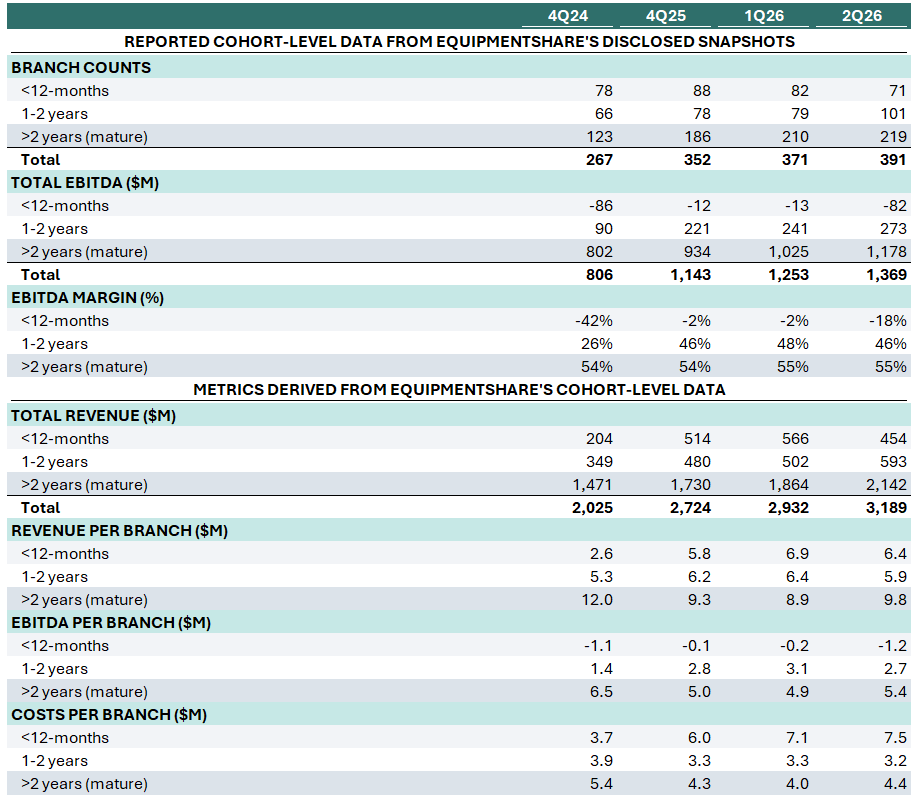
Source: EQPT Cohort Disclosures
By aggregating the cohorts and deducting OWN payouts, we can also see the margins for the overall network.
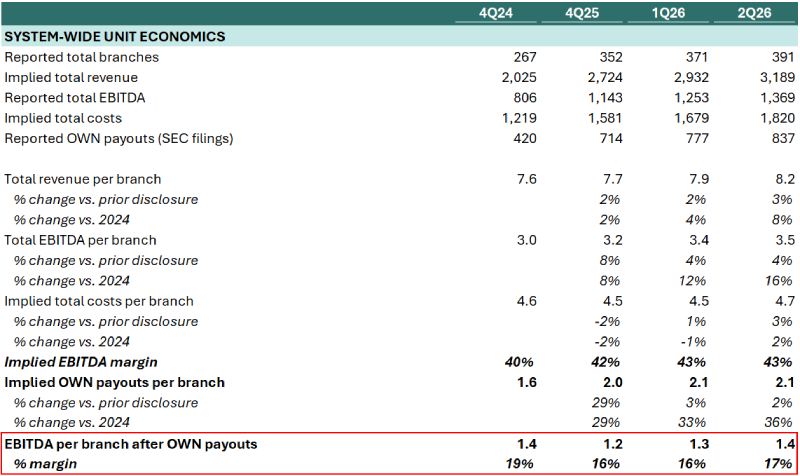
Source: EQPT Cohort Disclosures, SEC Filings
Across the 18-month period, the Company’s mature cohort grew by 96 branches (78%) – from 123 branches to 219, with those entrants accounting for almost half the mature group as of 2Q26.
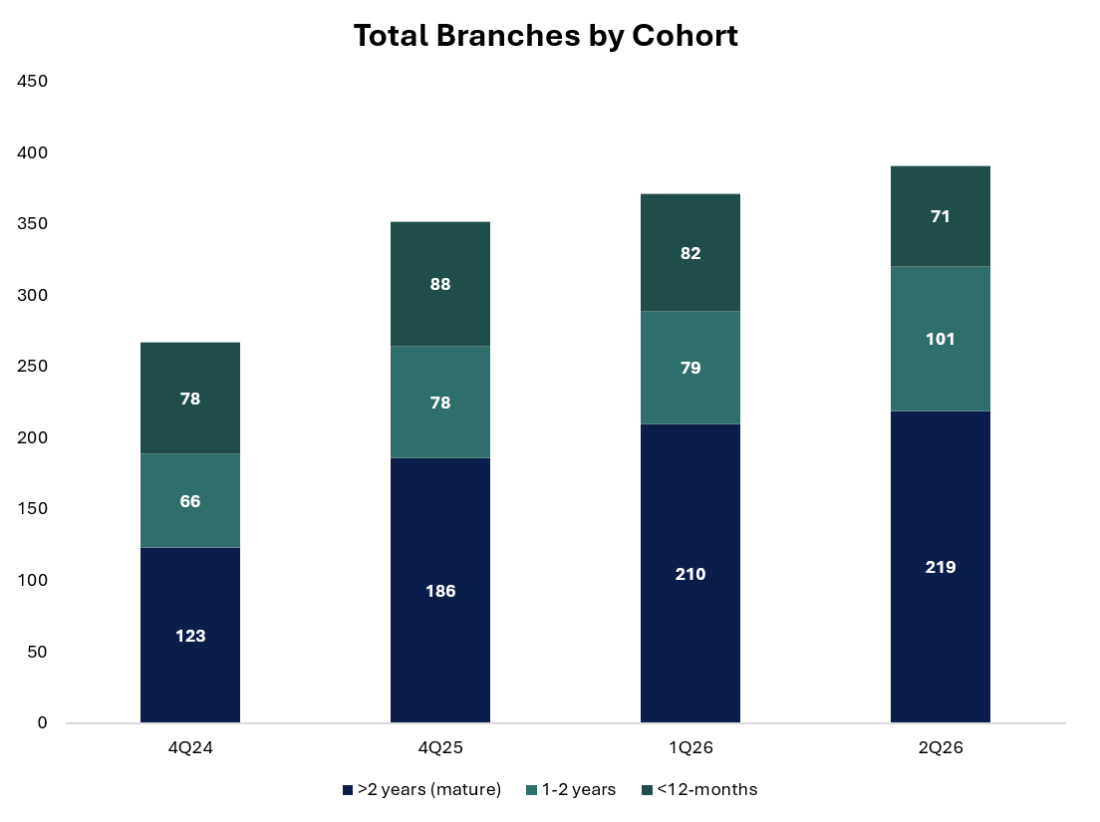
Source: EQPT Cohort Disclosures
These entrants transitioned from the 1-2-year bucket, which generated 60% lower median revenue per branch than the mature sites across the analysis window. Predictably, upon graduating they dragged the mature cohort’s revenue per branch down 18%, from $12.0 million to $9.8 million, and as low as $8.9 million in 1Q26.
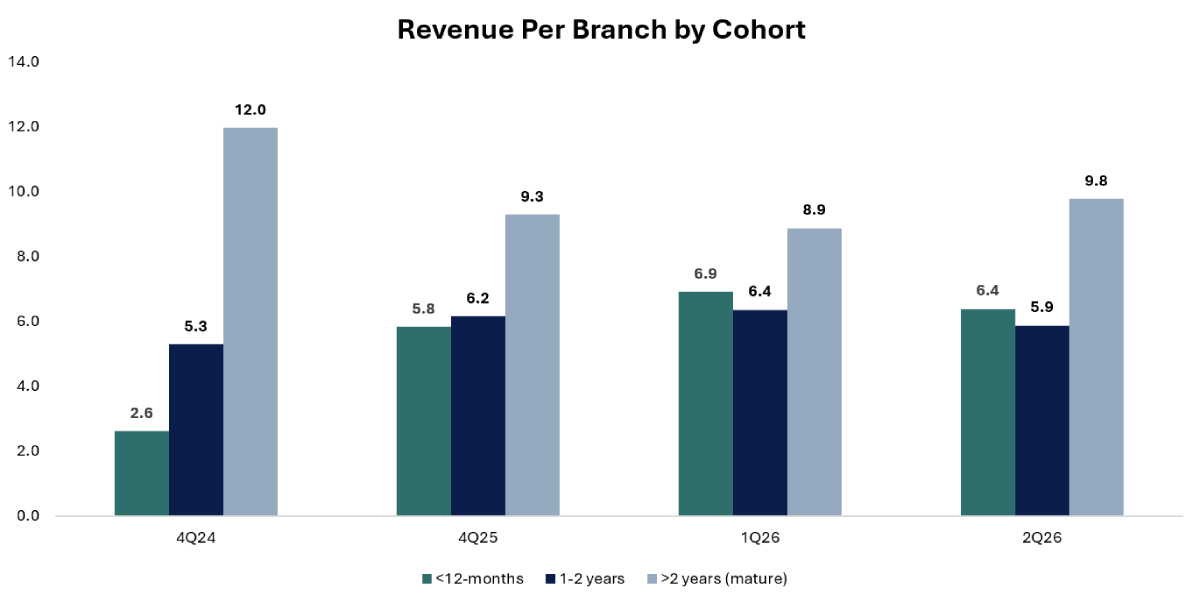
Source: EQPT Cohort Disclosures
Rental branches grow revenue over a fixed cost base, and margins expand as they scale. Conversely, smaller branches spread fewer dollars over the same rent, staff and overhead, and run thinner. This is the exact operating leverage that underpins EQPT’s own story about how branches ramp. It is therefore mind-boggling that despite absorbing nearly a hundred subscale units, EQPT’s mature-site EBITDA margins never budged across the four snapshots: 54%, 54%, 55%, 55%.
The mature cohort added $376 million of EBITDA on $670 million in revenue over the 18-month period. The results imply a 56% incremental EBITDA margin on the revenue gained, which we find bewildering because the subscale branches that arrived were part of the 1-2-year cohort which had median EBITDA margins of 46%. Again, it also runs contrary to the chaotic, money-losing operations formers outlined.
The performance coincides with apparently anomalous trends in the underlying data. We believe all four of EQPT’s cohort snapshots are distorted by accounting games, but only FY24 somewhat resembles a functioning rental network. <12-month branches made about a fifth of the revenue of mature branches on about 68% of the costs ($3.7 million against $5.4 million), and 1-2-year branches fell in between. Every snapshot since has presented, in our view, a clearly illogical picture. By 2Q26, <12-month branches are shown incurring 71% higher total costs than mature sites ($7.5 million against $4.4 million), and 134% above 1-2-year branches ($3.2 million).
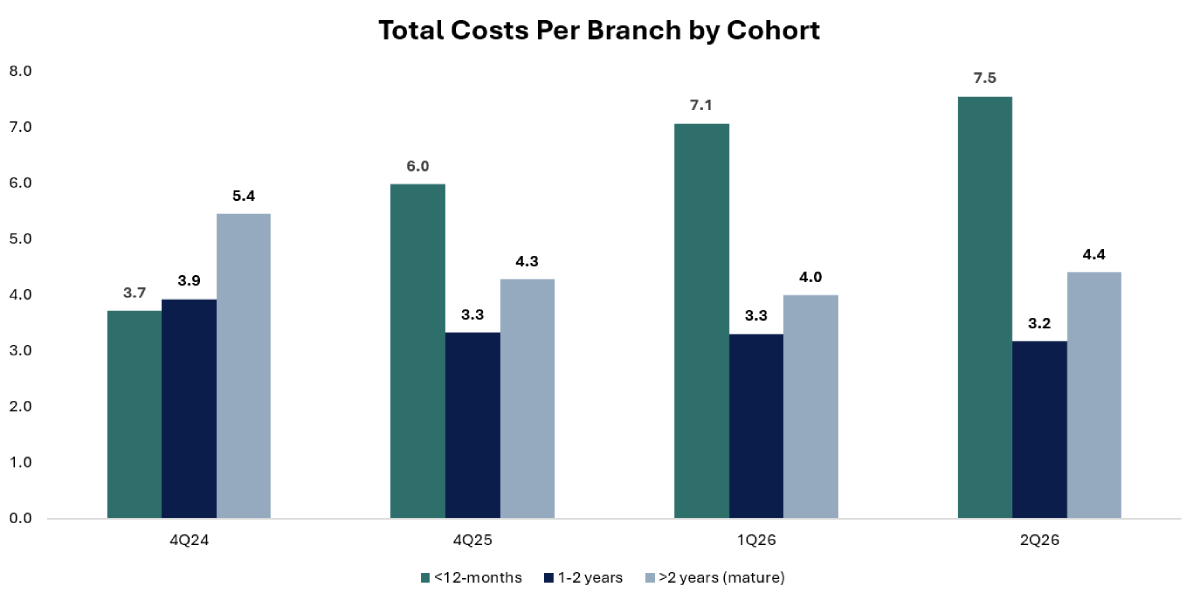
Source: EQPT Cohort Disclosures
Suspiciously, just as first-year branches got more expensive, second-year branches abruptly became cheaper. Sites opened in 2023 earned 26% EBITDA margins in their second year; those opened in 2024 earned 46%.
Source: EQPT Cohort Disclosures
Management attributes the large costs at first-year branches to “New Market Start-Up Cost,” a line item it has never squarely defined, that the market has taken at face value, and which we believe is a subterfuge that obscures the true driver of EQPT’s climbing costs.
“New Market Startup Costs” – the $250+ Million Black Box EquipmentShare Relies Upon to Explain Away Unique Year-One Branch Losses

Source: Umibōzu Meme Department
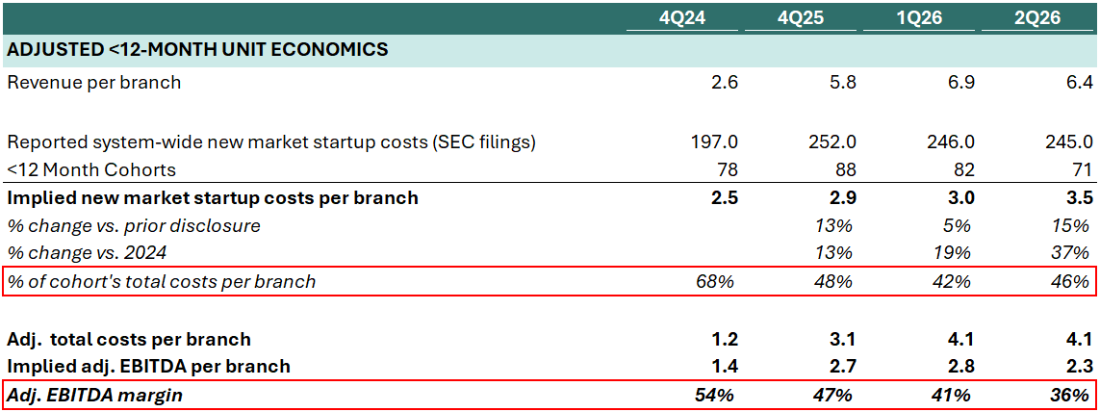
“New Market Startup Costs” ran $245 million over the TTM-period ended June 2026 [Pg. 2], added back as ~13% of EQPT’s reported “Adjusted Core EBITDA”, but we can’t find definitions in its 10-K and 10-Qs for them and earnings releases simply justify the add-back. A credit agreement [Pg. 57] says these costs are whatever management deems them to be, illuminating, we believe, their susceptibility to manipulation.
“New Market Startup Costs” shall mean costs, charges and other expenses incurred by Parent Borrower or its Restricted Subsidiaries in connection with newly created locations; provided, that (a) such costs, charges and other expenses are incurred within the first twelve (12) months of the creation of any such new location and (b) such costs, charges and other expenses are such designated as “New Market Startup Costs” by the chief executive officer, chief financial officer, principal accounting officer, treasurer or controller of Parent Borrower in a manner consistent with past practice prior to the Closing Date.”
To disarm investors and make “New Market Startup Costs” seem as though they are not worth a second look, management portrays them as unavoidable. It asserts [Pg. 5] the add-back provides “greater transparency” and “enhanced comparability” with peers that don’t report, or adjust for them, because they aren’t expanding at the same pace organically.
“As the only large-scale equipment rental provider that is fully focused on organic growth, excluding new market startup costs provides greater transparency with respect to the Company’s financial condition and results of operation as it enhances comparability with industry peers.”
We find it curious that EQPT claims it’s uniquely exposed to these costs. Management says new sites open with demand at the jump, and formers told us they use significant latent capacity (fleet, people) to open, which should make them “warmer” than sites set up completely from scratch. Management touts this “dramatic pull-through” as the foundation of its 700-site plan.
“And then the organic as well, when you think of the organic stores, these are not necessarily new customers. There’s lots of new customers that we want to be absolutely capturing as much of the industry as possible, and that’s what we’re doing. But a lot of those customers, you’re seeing 75% when you’re looking over there are existing customers. So, we already have dramatic pull-through from sites that we’re opening, and that pull-through is reflected in this chart as you see the organic growth in the 700 sites by 2030.” – EquipmentShare CEO Jabbok Schlacks – Oppenheimer Conference (May 4, 2026)
Strangely, in June 2026 Mark Wopata – EQPT’s EVP of Finance and Chief Data Officer – explained the first-year burn at EQPT’s branches includes “overhead, overfleeting and overstaffing” – which we see as recurring costs that branches grow into, not one-time items.
“And then when we start sites organically, like you said, there’s an initial upfront investment where we burned about $2.5 million per market in the first 12 months. And so that – they’re not profitable, like we said in the first 12 months. That’s coming from overhead, overfleeting and overstaffing.” – EquipmentShare EVP of Finance and Chief Data Officer, Mark Wopata – Wells Fargo Investor Conference (June 9, 2026)
Experts we spoke to flagged EQPT’s guide of $2.5 million per branch as suspiciously high on its own and reported figures have run well above that at $3.5 million for the TTM-period ending June 2026. According to a former CFO from a leading competitor, true one-time opening costs that affect EBITDA should be negligible.
“So, there’s all these schemes everywhere, right? And I think at the end of the day, the margins are just trash and the business model, you know, the results really don’t sustain their hype. In terms of, and I haven’t heard, you know, that’s interesting and kind of desperate, I would say, because there’s not that much cost in terms of EBITDA costs to starting up a branch, right? Most of the investment is all capital. You’ve got to put in a couple of million dollars worth of PPE for trucks and support and getting the branch up to speed and sort of improvements and then fleet. So, there’s not a lot of, you know, EBITDA costs in terms of starting up a branch.” – Former CFO of Leading Rental Company
None of the numerous former EQPT branch operators we spoke with could confidently tell us what is in this bucket, let alone explain why it is anywhere near the size reported. Echoing the view of the industry executive above, a former Regional Manager with dozens of branches claimed new units carry some set-up costs, but that most are capitalized and depreciated rather than expensed through the P&L.
Interviewer: “What are the unique costs associated with opening a branch that don’t show up after 12 months? Like, what, what even are those?”
EquipmentShare Former Regional Manager: “I mean, if there’s no construction, I mean, there’s really — and that would be depreciated also. I mean, so there’s no cost to set up a branch that would be, I mean, trucking in the equipment, I mean, that’s all — a lot of that, especially if it’s new, it’s captured in the OEC of the machine. So, there’s nothing that is truly a unique startup cost where you’ve got to do something that is a one-time fee — I mean, maybe you got turning the power on, I mean, but it’s minimal dollars. I mean, you’re not talking hundreds of thousands of dollars here. I mean, that [LOCATION] branch, I mean, literally, I think I opened the whole branch myself, and I didn’t have any cost, like zero out-of-pocket cost for the branch.”
Interviewer: “And that was across all of — like, that wasn’t unique to — that’s just like across your whole coverage, and it should be the same across everywhere?”
EquipmentShare Former Regional Manager: “Yeah, it’s the same everywhere.”
EQPT’s cash flow statement [Pg. 85] appears to show that upfront investments in fixed assets for branches are capitalized. The Company disclosed $186 million, $195 million and $248 million in “Purchases of and deposits on property and other fixed assets” in 2023, 2024 and 2025, respectively. We believe any fleet purchases for branches would also be captured there under “Purchases of rental equipment.”
Within EQPT’s own data, New Market Startup Costs behave more like a sponge than true set-up costs. For example, we’d expect that adding these costs back to EBITDA would result in normal first-year margins, but instead it lifts them to an implausible 54% in FY24, level with EQPT’s own mature sites. Since then, the adjusted margin has come in at 47%, 41% and 36%, all still above the 31.6% that Sunbelt’s first “3.0” cohort (72% greenfield) earned in its first year. We doubt that branches our sources describe as chaotic and loaded with junk fleet out-earn Sunbelt’s greenfields.
Source: EQPT Cohort Disclosures
So, if opening a branch comes with minimal above-the-line costs, as the sources above told us and the data suggests, what exactly is in this bucket that runs ~$250 million a year? As we show next, numerous former employees describe a widespread scheme to push costs from older sites onto new ones to prop up the ramp narrative. We believe this line item is a shield that excuses losses and draws scrutiny away from their true cause.
“The Netflix Documentary Part” – Multiple Formers Reveal How EquipmentShare Hits its Touted 55% Mature-Site Margins; Millions of Dollars of “Junk” Gear Dumped on New Yards, “Fishy” Charges, Recycled Prior-Year Invoices & More

Source: Umibōzu Meme Department
The step-change in the data above lines up with where a former Regional Manager says EQPT began shifting its focus to openings over profits in 3Q24
“I would guess, maybe mid-’24, actually early ’24, the focus was really, we would go to Columbia once a quarter and, and we would talk about how we can make these branches profitable and what we want. And then after that, the next quarter it shifted to, in, in third quarter 2024, it shifted to let’s, let’s open. How, instead of focusing on what are we doing to make these branches profitable, it was like, how many branches do you plan on opening? What’s your hurdles with getting branches open and why?” – EquipmentShare Former Regional Manager
The same source added that it was around that time that branches also began getting hit with unexplainable month-end charges they “couldn’t research or contest.”
“Like, if you’re at United and, and you’re at a branch, you know, on September 3rd what your August numbers were. You know, it’s closed. You already know everything’s done for the most part. It may go to the 4th or 5th. At EquipmentShare, sometimes that shit would go to 30, 45 days before branches would see their P&Ls for the previous month. So, making changes to help your P&Ls or everything. So we complained and complained and complained about it. Finally, they started giving us a semblance of a live P&L so we could, we could finally see where we were at actively live at all times. The problem is, is that worked, that worked until about the 25th day of the month, and then it always had issues. And then suddenly you were hit with all these bullshit charges that you couldn’t research or contest.” – EquipmentShare Former Regional Manager
The former District and Regional Managers we spoke with each described how mature branches systematically moved huge volumes of surplus equipment – much of it “hard-down” (broken) – to new openings, taking the associated operating costs (hauling, maintenance, salaries) off their own books in the process.
“When a new branch opens all the other branches in that district dump their hard-down assets and low utilized equipment to the new location. This improves utilization and gets the carrying cost of that [g]ear off their books. All new locations are judged on top line revenue not profit. They also will absorb several other expenses such as outside hauling fees and sales rep payroll.” – EquipmentShare Former District Manager
We checked whether fleet shuffling merely moved depreciation, which sits below EBITDA and would leave the margins EQPT reports untouched. But the witnesses insisted a game of hot potato shifted substantial above-the-line expenses too.
Interviewer: “And so if you were to add back the depreciation on that, what would those margins get to.”
EquipmentShare Former District Manager: “Honestly, without the depreciation, they would have all been in the hole still because, well, I mean, most of the equipment we had was junk. It’s hard to say because unfortunately we were the redheaded stepchild region. We got everybody else’s junk. We very rarely got new equipment. And when we did, it was not equipment that we actually needed.”
Interviewer: “So, when you were getting all that junk, was that some of these other mature branches just moving their stuff onto you guys?”
EquipmentShare Former District Manager: “Yeah, they would shift. So, it was done both company-wide and inside of the region. It was done to, you know, shift costs and basically de-fleet at the end of the month so a branch would be profitable.”
They said the repairs hit the receiving branch’s P&L, along with the labor to do them – several service technicians would be at a brand-new branch, working through “piles and piles of broken equipment” dumped on its lot. The result, they said, was new branches losing $500,000 to $600,000 a month.
Interviewer: “If you go and repair that, would those costs hit your branch or the branch that they came from?”
EquipmentShare Former District Manager: “No, they would hit the branch doing the repairs
…
If you have Branch A that’s 3 years, 4 years old established, and say there’s Branch B is a new branch 40 miles away, instead of incurring all the cost of any hard-down major repairs in the existing branch, you ship it to the new branch and have them do the repairs and incur the cost, which is why the newer branches were losing, you know, $500,000, $600,000 a month… New branches were immediately running 5, 6, 7, 8 guys in the shop because they’ve got just piles and piles of broken equipment to repair.”
A former Regional Manager vented about spec’ing the right equipment for a new yard – their primary job on the fleet side – only to watch other branches push pieces it didn’t need onto it “for the numbers.”
“But if you’re in [MARKET], you look at a 12K telehandler and, you know, it’s $180,000 price tag and you’re like, man, I don’t know if I really want that, if I can afford that. But then you end up getting one anyway. Because they’re a new branch and because their district manager says, hey, for the numbers, we’re going to – we’re going to put this over here.” – EquipmentShare Former Regional Manager
Most of the people we spoke with stressed the same incentive: for their first 12 months, EQPT judged new branches on revenue alone, while mature locations were bonused on profit.
“Improving utilization in certain areas and making certain areas look more profitable by shipping all the garbage out to the new locations that they don’t report on… their model, the first 12 months they don’t report. They don’t report gains and losses on new locations in the first 12 months. They don’t consider them active until they’ve been open for a year.” – EquipmentShare Former District Manager
The incentive cuts both ways. Because losses don’t count against them, new branches don’t have much reason to turn away excess fleet. If anything, more equipment on the lot means more to put on rent against the revenue targets their bonuses hang on. And whoever is operating the new branch knows the hot potato can always be passed to the next opening once the 12-month window closes and profits matter.
“If I’m a new branch manager in the third month, like initially, I don’t care how much fleet you send me because I’ll get rid of it over time. … I just need revenue… if I can generate revenue, whatever it is, I don’t care if it’s a jumping jack or a 185-foot boom, it doesn’t matter to me. I just want to be able to rent whatever I get.” – EquipmentShare Former Regional Manager
EQPT’s cost shifting has allowed it to tell a rosy ramp story. However, during our interviews formers frequently alleged accounting chicanery which raises even broader concerns about the overall reliability of its reporting. More than one source reflected upon expenses from prior years landing on later-period P&Ls with no explanation. One former District Manager cited 2024 invoices showing up in 2025 financials, along with “random” bills for hauling or marketing.
Former District Manager: “It was real common on P&Ls or abandoned branches that the corporate would just throw these random expenses, like, oh, we’re going to throw this over on this branch. And it could be even, we were getting 2024 expenses that were showing up on 2025 P&Ls, like stuff getting passed over from previous years. And then pop up and call the corporate and say, hey, what’s this $15,000 on the P&Ls?”
…
Interviewer: “So, you’d see like branch level, like branch level P&Ls that would have these other expenses coming through that you wouldn’t be able to reconcile with what was happening at the branch?”
Former District Manager: “Oh, gosh. Yeah. Big time. Big time. … And it’d be from previous years, like invoices from 2024 showing up on 2025, like June P&L for $4,500 for an outside hauler bill or some random marketing fee or something like that that would just come out of nowhere and there’s no explanation for it.”
Others described charges that one called “fishy” – unexplained corporate costs, depreciation that didn’t tie to the fleet on their lot – and, when they asked, were told the Company was “still working out the bugs.”
“I started looking at P&Ls and I’m like, hey, what is this line? You know, what is this line item? And I would dig into it. They’d be like, oh, well, you know, that’s just a corporate cost for this and that. And they would try to explain it. I’m like, well, that doesn’t explain — I don’t get it. And they’re like, you know, we’re still working out the bugs on that. Or— our depreciation costs would be through the roof one month. And you’re like, you know, this doesn’t tie into my OEC. Why am I getting charged for this amount of depreciation when my OEC is this amount? [Corporate would say] Oh, you know, we’re still working out the bugs on that. It was kind of fishy to me.” – EquipmentShare Former Regional Manager
The same game apparently runs on the revenue side. A former District Manager described writing contracts out of one branch while booking the revenue at another that needed to “look profitable on paper.” They called new stores “cost centers” and said that by month 13 the costs would simply be kicked down the road to the newest one.
“You basically can do whatever you want to do for the first 12 months, but month 13 you better be turning a profit. What it forces you to do is if I’ve got a district of eight stores and I’m paying a gross amount of depreciation on gear that may be down, hard down, soft down, not going on rent, basically I’m paying the note on all of this… When you open up a new store, what do they tell us to do? Just take all of your costs and move them to that new cost center. Basically, let’s just keep kicking the can down the road. When we get to month 13, we’re going to move all that gear to the newest cost center and then we’re going to start writing contracts out of one cost center but pushing the revenue to another cost center and we’re going to do whatever we need to do to make it look profitable on paper.” – EquipmentShare Former District Manager
A former Regional Manager detailed how contracts were steered to whichever store needed them, and time the closings, so that a particular site would hit its monthly number.
“On the revenue side, you can, you can move contracts, and if something’s on the line, then a certain branch gets that contract, and then the newer branch just happens to, you know, hey, we’ll get you on the next one. We’re really trying to make this, this number for you know, store number 17 or whatever you want to call it, that, well, they’re right on their line where they need to be for the employees to bonus, they’ll say. And then, you know, they’ll get a certain contract. Certain contracts will close at the right time in order to hit a monthly number.” – EquipmentShare Former Regional Manager
One former District Manager put the scale of the equipment being moved at “tens of millions of dollars of OEC” at a time in a single market and recounted raising the audit risk with a superior who replied, “Wall Street doesn’t care about that.” Their experience squares with that of other sources who recalled concerns being waved off. They also indicated this practice was intentionally not put into writing.
“I said, look man… When auditors come in, my name’s going to be on all of this. You’re telling me to do all this, but you’re not putting it in writing. When all this comes to light, my name’s going to be attached to this. His response to me was Wall Street doesn’t care about that. I said, well, I’m not talking about Wall Street. I’m talking about investors, the likes of Capital One. They’re not going to send Bob’s tax service in here to do an audit. They’re going to come in here and dig into this and really look at what we’re doing. I just wasn’t comfortable doing that… It’s not like I was moving a few thousand dollars a month around. If I get audited, I get slapped on the wrist and say, okay. You’re talking about moving millions of dollars of OEC, tens of millions of dollars of OEC in some cases.” – EquipmentShare Former District Manager
Numerous Former Employees Allege Multiple Sets of Books at EquipmentShare, Along with Lapses in Internal Controls That Made an Audit Firm “Choke on Their Tongues”
We appreciate the gravity of the allegations we have documented thus far; however, we believe they are part of a broader pattern of obfuscation and financial deceit at EQPT.
Source: Reddit
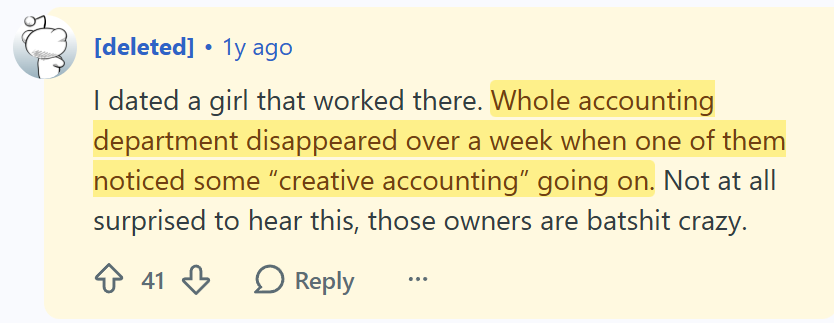
Multiple former employees have told us in recent months that the Company has, at least for a period, kept more than one set of books.
We first heard the allegation from a former employee who recalled an episode in the EQPT headquarters parking lot involving Jabbok Schlacks’s now-ex-wife, Danielle:
“I don’t know if you know, Jabbok and his wife split up
…
she showed up at headquarters in Missouri and was outside screaming in the parking lot, I want to see both sets of books.’” – EquipmentShare Former District Manager
Divorces can be messy, and on its own this account would not carry much weight. But the same witness said the story was not theirs alone: numerous people at the Company, including senior ones, had told them the same.
“I always was told there’s two separate books. I mean, I was told that by numerous people, like high-level people too. There’re two sets of books.” – EquipmentShare Former District Manager
A second former employee then corroborated the claim, saying they had seen it firsthand and that as many as 20 people knew.
“At one point in their history, and this would be about 4 years ago-ish, there were at least, at least 2 sets of books. I don’t just speculate this, I know it. I saw it. I know it.” – EquipmentShare Former Finance Manager
A third former in the finance department gave a more detailed account, tying the second set of books to the shuffled expenses and to manipulated bad debt. They also noted that the people who took EQPT public “from an accounting perspective” were, by their account, the same people who had done the manipulating.
“So, whoever took them public from an accounting perspective, those are the same people that manipulated the bad debt. They would roll back bad debt every time we would ask for a write-off… they would just keep moving it around, slicing it up and down, manipulating their accruals. You name it, they did it…..
I do believe they did run with two sets of books. Why do I say that? Cause again, I had access to their tables, their queries, and I could see different reporting. I could see different rollups from a branch level. I could see where branches paid for, you know, expenses prior months but were hit again with them. The bad debt was all over the board. They would just randomly hit branches, and a couple of the managers were smart enough to look deep into their financials to realize they already took that hit.” – EquipmentShare Former Finance Manager
A former operations executive said bad debt was a huge problem at EQPT during their pre-IPO tenure and that the Company approached these matters nonchalantly.
“But, but really, it’s not, um, you know, there’s a lot of gray area and a lot of, um, kind of the nonchalantness of, of the whole entire company, I guess, you know, where, uh, kind of like a lot of these other things that we talked about, like, it’s— What would be considered a problem at any other rental company is kind of like, well, You know, not a big deal. It’s just $50 grand. Well, whatever. But the compounding effects of $50 grand times, you know, 400 stores is a lot of money.” – EquipmentShare Former Operations Executive
We clarified with the same former what they thought EQPT’s bad debt may run at and how it compared to other companies. They pegged slippage at likely “a little over 20%” for EQPT compared to peers at 3-4%, while acknowledging the figure would be difficult to quantify because “the books were never really closed clearly.”
EquipmentShare Former Operations Executive: “You’re probably looking at— you’re probably missing out on a little over 20%. You know, the oil and gas market Um, meaning, you know, West Texas, some of the North Dakota, Permian Basin, New Mexico, which generates a tremendous amount of revenue and on paper generates a pretty solid amount of profit. But the back end of not, not handling those, um, receivables correctly or drawing them out, you know, means that in all reality you’re, you’re, you’re kind of retaining 60, 65%, or 65 cents on the dollar. Um, so it’s a little bit better in some of the other markets, but I would say you’re, you know, 75 cents to 80 cents on the dollar of actual, uh, dollar to dollar.”
Interviewer: “That sounds, uh, yeah, that when you put it that way, that, that does sound like a big problem. Um, but like, what do you think it is with peers?”
EquipmentShare Former Operations Executive: “Um, we would, we would know, we would never go over 3 to 4% on bad debt. Um, now that number for them is, is probably, it’s quantifiably You know, it sounds high, higher than it probably actually is, but that’s because it’s never— I don’t— the books were never really closed clearly Like, it’s, you know, oh, we’re gonna move this over here, we’re gonna, you know, draw this out, or we’re gonna go on this plan, or I’m gonna settle this for that. So, um, it was really hard to find the number, but I knew the number was was much higher than the peers..“
According to another source, EQPT hired an outside firm in about 2023 to assess its IPO readiness, only for the Company to pull them off the job after they asked basic questions about credit limits and collections – questions whose answers, they said, led straight back to “Mr. Schlacks.”
“They had hired an outside auditing firm basically to come in and provide some commentary on what was necessary for them to do to become IPO ready… They had reached out to [my supervisor] and said, can you provide us some information on, like, credit limits? … Credit limits, stops in the systems, what’s your scorecard, how does collections work… he came back and said, well, we don’t have any of those… This is how we determine credit limits. However, they don’t really mean anything… Because they’re just— no one pays attention to them.
…And at that point, the auditors basically, you know, all choked on their tongues and [were] like, I’m sorry, what? Can you please explain to me why? … And his response was… you should maybe ask Mr. Schlacks. And that was the end of that. Seriously, they pulled them the next day and then did nothing about the problem… It was assumed that they didn’t like what the auditors had to say and they didn’t want to do anything about [it].” – EquipmentShare Former Finance Manager
Amid Abysmal Utilization & Money-Losing Branches, EquipmentShare’s Online Listings Show 36% of Its OEC Up for Sale, Including $700 Million of Current-Year Gear

Source: Umibōzu Meme Department
Between the end of 2023 and 2Q26, EQPT grew OEC 82% to $9.9 billion, 83% of it through OWN, which now holds 56% of its fleet. Despite aggressively expanding its footprint, EQPT’s OEC per branch has held around $25-30 million throughout the period, roughly double the industry leader United Rentals.
Source: SEC Filings
We believe EQPT’s oversized fleet is a key driver behind its branches’ losses. A former operations executive with veteran experience in the industry explained their tested playbook for optimizing branch profitability took a backseat due to EQPT’s determination to accumulate exorbitant amounts of fleet.
“I spent a lot of time, a lot of equity implementing long-term operational strategies to develop healthy, profitable growth in branches. And that was kind of counterproductive to the fleet department’s strategy, which was kind of oversaturate every market. You know, we’re buying so much fleet, it’s got to go somewhere. You know, so having several battles in between regional districts and general managers about, you know, how are we ever going to kind of run a successful branch if I have $40 million in OEC when my market’s only going to produce $20 million of OEC revenue, the staffing around that… So, and ultimately, I just, I figured out, I guess, that their strategy on revenue growth and, you know, extreme expansion was never going to align with… that’s building sustainable branches the way that I knew how in the rental business.” – EquipmentShare Former Operations Executive
This also likely explains why EQPT doesn’t report utilization despite claiming to possess technology that provides great data on its equipment (T3). A former told us the metric was guarded even internally: branches rarely saw their numbers, and when they did, it was a “made-up version.”
“[Management] never wanted to talk about it [utilization]… they never wanted utilization shared. They would never really give the branches their financials, and if they did, it was a made-up version.” – EquipmentShare Former Finance Manager
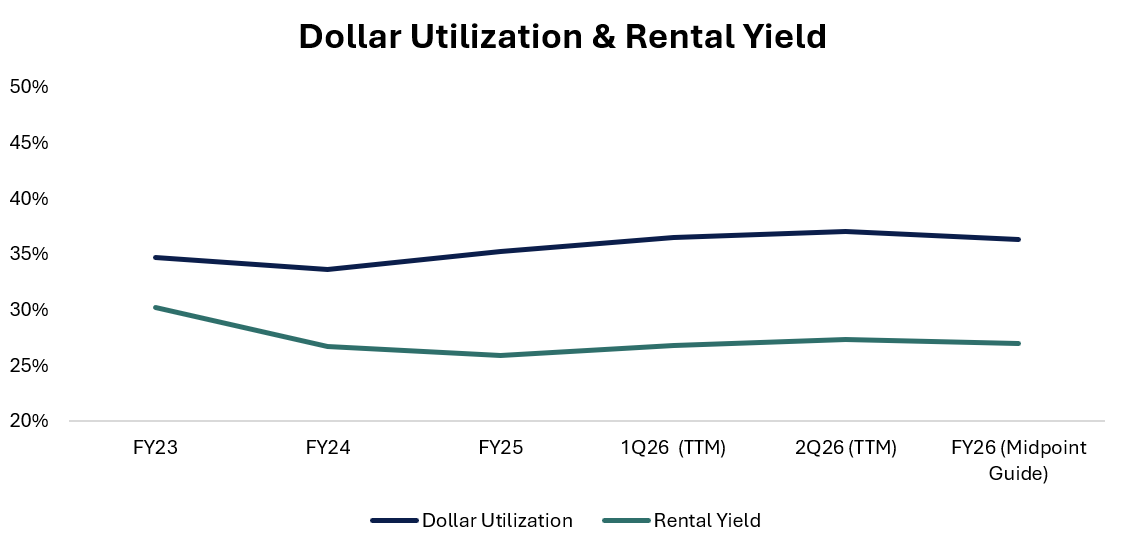
The best public proxy, dollar utilization (rental revenue over average OEC), has sat in the mid-30s for years. Meanwhile, our analysis shows rental yields (rental revenue less OWN payouts over average OEC) have been flat at 27% since FY24.
Source: SEC Filings
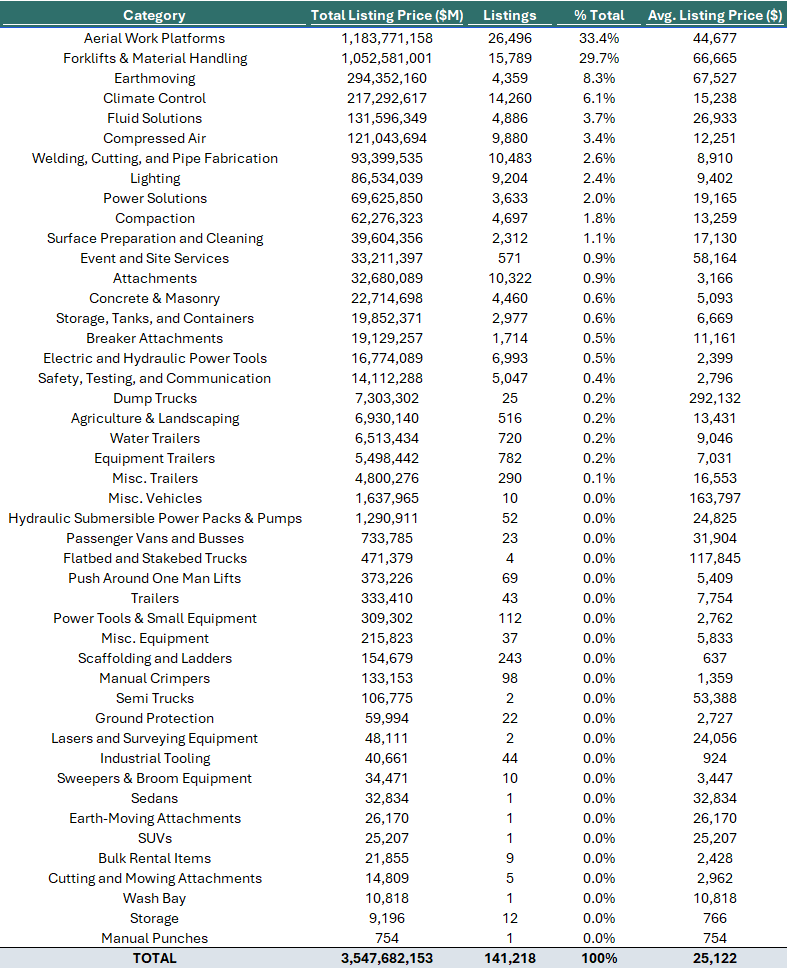
We believe suspiciously high amounts of EQPT’s used equipment listed for sale on its website may indicate it has more fleet than it can utilize efficiently. As of August 19th, 2026, we scraped public listings for 141,218 pieces of equipment across 353 locations, with asking prices totaling $3.5 billion, or 36% of EQPT’s OEC at the end of 2Q26. The listings are not only large relative to EQPT’s fleet but far exceed what peers United and Herc have listed, and they include thousands of 2024 to 2026 model-year units, well ahead of normal disposal timelines. (See Appendix III for listings by category and state).
Almost $1.9 billion of the equipment on offer (53% of total listing price) is model-years 2024 to 2026. Another $1.2 billion (35%) is model-year 2021 to 2023. Together, $3.1 billion, or 88% of everything EQPT has listed, is 0-5 years old.
Source: EQPT Used Equipment Listing
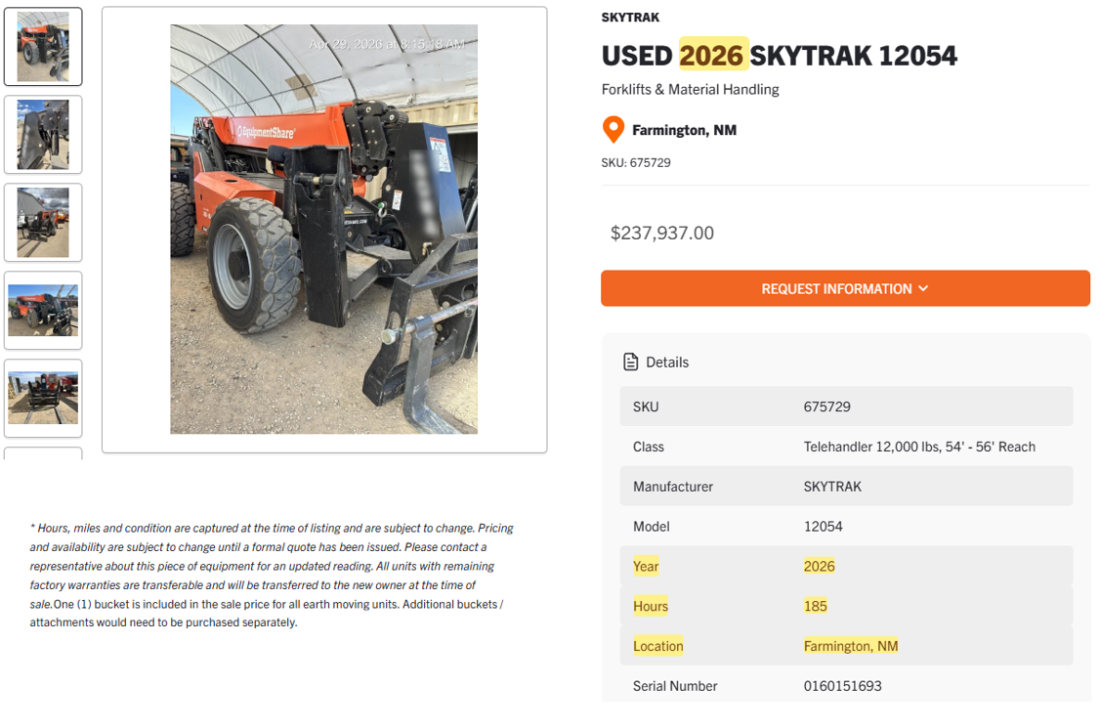
We found significant fleet listed in markets where EQPT is supposedly expanding aggressively. In December 2025, the Company announced plans to open 5-10 locations across New Mexico. Yet, our research shows EQPT has ~$114 million of fleet listed in the state, $35 million of which is 2026 equipment. Below is a neat 2026 Skytrak telehandler for sale with 185 hours. The item now sits in Farmington, New Mexico, a site that The Premiere Group, the Schlacks family office, acquired on August 14, 2026, and does not appear to have opened officially yet.
Source: EQPT Used Equipment Listing
Louisiana is another expanding market for EQPT where our data shows $133 million of equipment on offer.

Source: EquipmentShare Used Equipment Listings
We also noticed young equipment listed for sale near megaprojects which EQPT cites as a key reason it can support more fleet than peers. We question whether it is unsustainably accumulating fleet to win and service these projects.
“We believe our scale and vertically integrated tech platform have positioned us to excel on the largest, most demanding projects in the country, as evidenced by our deep involvement with megaprojects. We currently rent to over 80% of active megaprojects inside our serviceable footprint. For example, on one hyperscale datacenter project, a customer replaced an incumbent provider with EquipmentShare and expanded from less than 20 to over 2,000 machines within four months. This expansion reflected both the customer’s underlying project growth and its adoption of our T3 platform, which the customer cited as a factor in its decision to transition from the prior provider.”
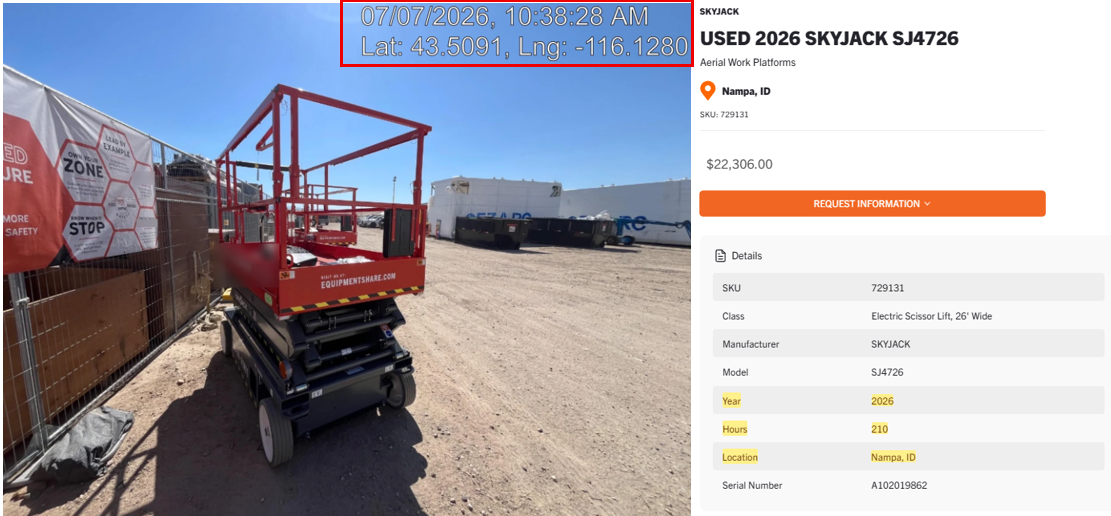
For example, a 2026 Skyjack scissor lift is listed with 210 hours, located at EQPT’s Nampa, Idaho branch for $22,306. It was photographed for sale on July 7, 2026 at coordinates that place it ~20 miles away, on Micron’s Boise fab site, one of the largest active megaprojects in the country.
Source: EQPT Used Equipment Listing
A former CFO of a leading rental company told us that selling anything younger than five years old is “a real red flag.” In their view, it suggests either real losses are being taken on the equipment or playing one of several accounting games. Based on the prices EQPT is listing these machines at we believe the latter is a real possibility.
“So it depends on, well, I mean, the key to look at, I mean, if it’s selling anything that’s less than five years old, then that’s a real red flag, right? They’re probably losing their ass on it and playing depreciation games. They could be moving in old fleet there and selling over-depreciating. I don’t know. They could be moving in old fleet and selling that just to show an equipment gain on those new, gain on sale of equipment on those new branches to get some EBITDA on it.” – Former CFO of Leading Rental Company
A former District Manager reiterated the 5-year “golden rule” explaining that aggressive disposal of young equipment suggests either a bloated fleet or “something else going on in the background.”
“The golden rule in the rental industry always was you know, 5 years, 5-year and flip your fleet unless you had a 20 to 25 percent profit margin on it… Why are you selling your fleet? Either You’re completely bloated and overfleeted, and you have to defleet, or there’s some something else going on in the background. I honestly don’t know. It doesn’t it doesn’t make sense. It doesn’t add up to anywhere. You know, almost 30 years in the industry…I’ve never seen anything like it.” – EquipmentShare Former District Manager
One explanation EQPT may provide for the extensive catalog is that it puts fleet it intends to enroll in OWN out on rent before it has found an investor for it. In our view, that read raises a more troubling possibility which we see as a hidden risk to its operations: EQPT is buying far more fleet than it can carry on its own balance sheet, well before OWN investors are lined up to take it. It also may explain a pattern in the cash flow statement. Sales into OWN run through operating cash flow, yet EQPT’s investing activities show aggressive fleet disposals on top of them. Measured against its company-owned fleet (~$3.7 billion), FY25 disposal proceeds ($1.2 billion) come to 31% of OEC, against 6% at United and 5% at Herc.
Conclusion: EquipmentShare Can’t Run & It Can’t Hide
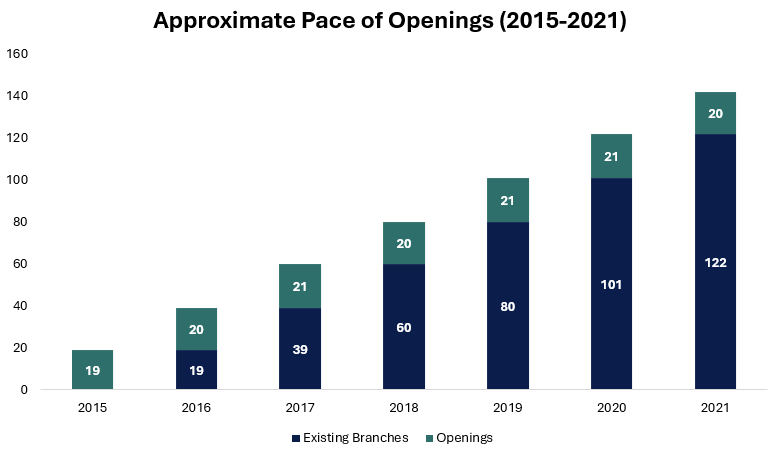
EQPT’s historical footprint data shows a clear inflection in branch openings around 2023-2024 ahead of coming public (See Appendix IV).
In our view, its breakneck expansion is not happening despite its poor branch performance but because of it. As we have outlined, EQPT appears to sweep costs onto new sites to prop up its mature branches, incentivizing openings.
We believe this has pushed EQPT into undisciplined site selection, which only compounds its problems. One former District Manager emphasized the Company wanting “another dot on the map more than anything”, sharing that they were even developing an app that would let any employee submit potential locations and collect a $2,500 finder’s fee if the site was chosen.
“They really want that, that market footprint or another dot on the map more than anything. They’re even talking about putting this app together, which I think is in the development stage now that where all the employees and sales reps and stuff have this app that if they’re driving down the road and they see a building with some bays and it’s got an available sign or for lease sign and you take a picture of that as a potential location, then you upload it into the app and shoot it to the corporate office. And they select that site for a branch. Then you’re paid like a $2,500 finder’s fee. That was, it was supposed to, this app is supposed to come out this year… And even every district sales manager and other people, we’re all, we’re supposed to be all keeping our eyes open for locations.” – EquipmentShare Former District Manager
We were warned that the way EQPT opens units puts existing sites at risk of cannibalization. A former branch leader explained the Company would inevitably have to consolidate or sell fleet.
“How many stores do you really need to open? … Down the road, there’s going to come a time where you can only have so many stores in so many locations with so many construction projects that are actually ongoing… And then do you have too many stores and do you have to start consolidating or selling equipment.” –EquipmentShare Former Accounting Manager
One former employee described EQPT fleeting up sites with “oddball equipment that didn’t fit”, “[running] through different managers” at struggling locations, and opening in markets that were “all failing”.
“There’s, you know, certain towns, there’s the Salt Lake Cities of the world and the, the Denvers of the world that can just have so much business and still run at high OEC and still be profitable. But they don’t make up for the, the Pueblo, Colorados and the Grand Junction, Colorados and the Colorado Springs and the Fort Collins and other locations like that. That are all failing. And they run through, through different managers trying to point the finger at someone and say, hey, you know, we didn’t have the right team in there in this first 18 months. Let’s try again with someone else. And it’s, you know, a very expensive lesson. I said it through my whole tenure there is EquipmentShare learns lessons at a very, very expensive rate. They bought a lot of oddball equipment that didn’t fit. They tried to rubber stamp their fleet plan into, you know, Florida versus Montana versus New York versus Southern California. And rental, you know, construction equipment doesn’t work. across every market. The same type of dozer doesn’t work in Florida as it does in Montana. So, it’s a very expensive rate which equipment share was learning.” – EquipmentShare Former Regional Manager
Beyond the site selection risks, we see a math problem for the charade. EQPT is on a constant treadmill because shifting costs to manufacture mature-site margins only works while openings keep pace with the mature base. Since FY24 the mature branch count has grown 78% to 219 while TTM openings fell 14% to 67. This puts the ratio at 3.3 mature branches per opening, up from 1.6 just 18 months ago, and by our math even 800 sites by 2030 takes it to 6.7.
Ultimately, we think EQPT will be forced to find a new way to hide its underperformance as costs at new branches would have to swell to a point that draws more scrutiny. Since FY24, revenue per first-year branch has grown 2.4x, yet these sites still lose money, because costs outside the startup bucket grew 3.4x, from $1.2 million to $4.1 million. Strip New Market Startup Costs out entirely and a first-year branch now costs more to run than a second-year branch with similar revenue: $4.1 million against $3.2 million.
Source: EQPT Cohort Disclosures
Eventually we think the music has to stop. We are short EquipmentShare (see disclaimer).
We’re still analyzing material that didn’t make this report, and we continue to dig for more. If you’ve worked at, rented from, or invested w/ EQPT, please reach out: https://umibozuresearch.com/contact-us/
Appendix
Appendix I: Stealth-Edited & Deleted Evidence of Wrongdoing Related to Our Initial Report on EquipmentShare
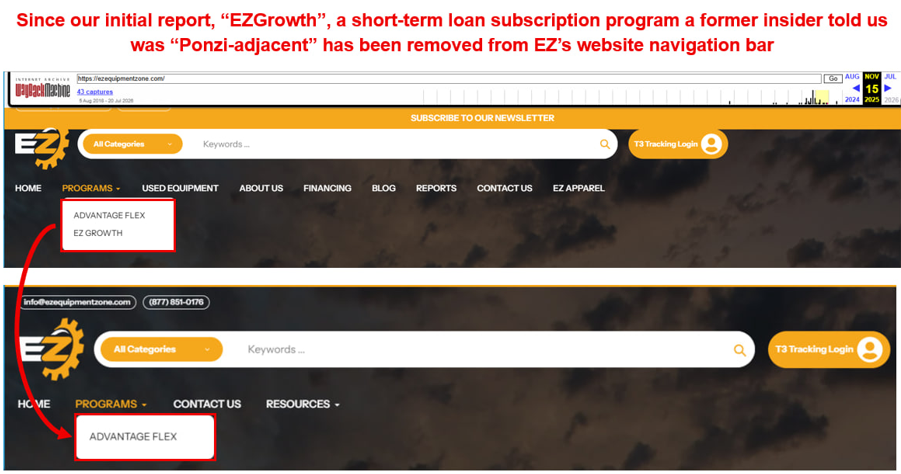
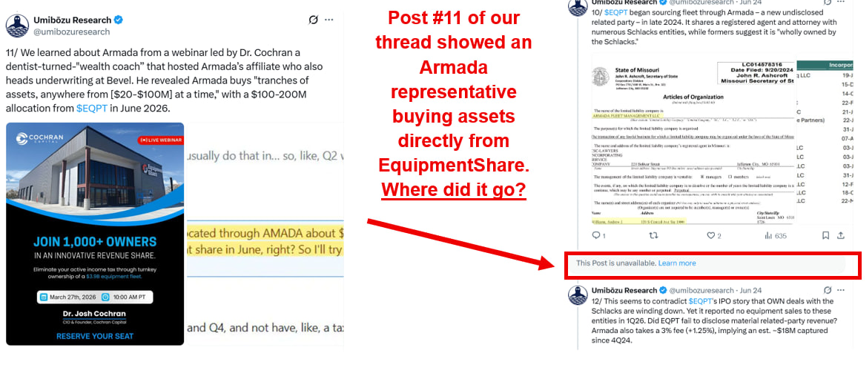
Behind the scenes, public-facing evidence of wrongdoing has been stealth-edited and deleted. Since publication, key OWN partner EZ Equipment Zone has scrubbed marketing for a program a former called “Ponzi-adjacent,” and the exhibit in our X thread showing apparent related party Armada buying hundreds of millions of dollars of equipment from EQPT is now mysteriously “unavailable” to view.
Days after we published, a reader posted our report on the subreddit for Columbia, Missouri, EQPT’s hometown. A moderator removed it within two hours.

Source: Reddit
Appendix II: Illustrative Ramp From Sunbelt’s “Sunbelt 3.0”
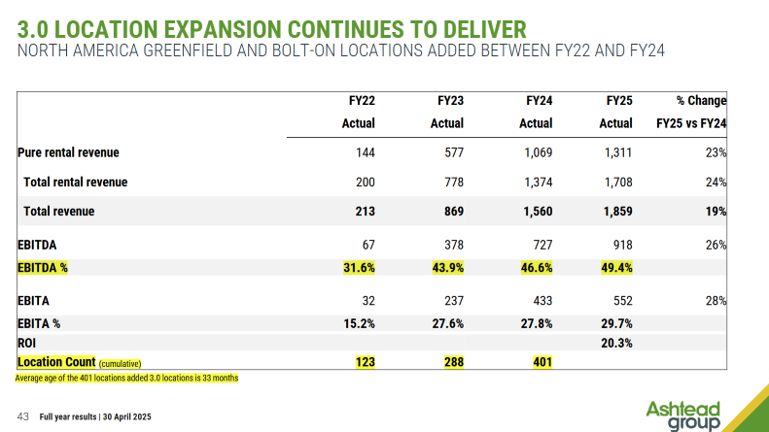
Sunbelt’s FY2025 Results broke out the economics of “Sunbelt 3.0,” a FY22-FY24 expansion that opened 401 units, 231 of them “greenfields”, which it defines as “new locations added to our store network through organic expansion rather than through acquisition.”
The initial 123-site cohort, 72% greenfield, earned a 31.6% EBITDA margin in its first year and reached 49.4% by an average age of just 33 months, with management guiding a further 200 to 300 basis points as it matures.
Source: Sunbelt FY2025 Results
Appendix III: Additional Data from EquipmentShare’s Used Equipment Listings
Listings by state:
Source: EQPT Used Equipment Listings
Listings by equipment category:
Source: EQPT Used Equipment Listings
Comparison vs. peers:
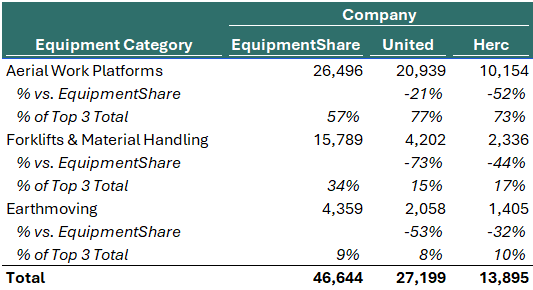
Source: EQPT Used Equipment Listings, United Rentals Used Equipment Listings, Herc Used Equipment Listings
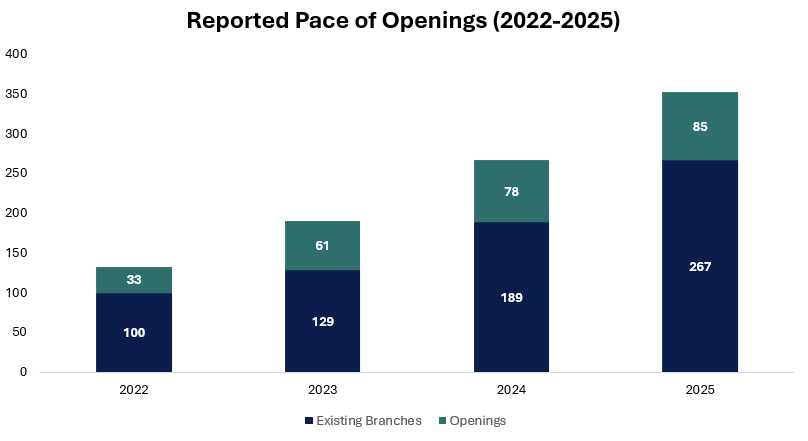
Appendix IV: Estimated Timeline of EquipmentShare’s Branch Growth Since Inception
EQPT discloses branch counts and openings since 2022. For the years before that, we took approximate figures from its own 10-Year Anniversary video, which shows a running total of its locations over time.
The picture is a steady clip of roughly 20 openings a year from 2015 through 2021, then 33 in 2022, 61 in 2023, 78 in 2024 and 85 in 2025. If anything, the comparison understates the acceleration as the video’s running total appears to include locations beyond pure rental branches (it ends 2021 at ~142 sites, against the 100 rental branches EQPT reported at the start of 2022), whereas the 2022-2025 figures count rental branch openings only.
Disclaimer
This report is a short-biased opinion piece. It should be read together with the Umibōzu Research Terms of Use and General Disclaimer at www.umibozuresearch.com, which are incorporated here by reference; by reading this report you agree to be bound by them.
You should assume that, as of the publication date, Umibōzu, the Umibōzu Affiliates, and/or the Capital Provider hold, directly or indirectly, short positions in the equity, debt, derivatives, or other securities of EquipmentShare (Nasdaq: EQPT) and stand to realize material gains if the prices of those securities decline. You should further assume that, upon or promptly after publication, possibly on the day or even the hour of publication, some or all of those positions will be covered, and that Umibōzu, the Umibōzu Affiliates, and the Capital Provider may buy, sell, cover, or otherwise transact in those securities at any time, before, at, or after publication, for any reason and regardless of the views expressed here, and may be long, short, or neutral at any point.
You should assume that Umibōzu has entered into an agreement with an unaffiliated third party (the “Capital Provider”) under which Umibōzu issued advance notice of this report and its contents and, in exchange, is entitled to a share of the Capital Provider’s trading profits in the securities of EquipmentShare, and therefore that Umibōzu has an indirect economic interest in the price of those securities in addition to any position it holds directly. More generally, Umibōzu may have arrangements with investment funds, managed accounts, family offices, proprietary trading vehicles, or other capital partners that may trade in these securities before, at, or after publication, and may receive compensation from such persons based, in whole or in part, on trading profits, gains, fees, incentive allocations, or other economic results relating to these securities. These arrangements create material conflicts of interest and may give Umibōzu incentives that differ materially from, or are directly adverse to, your interests. Umibōzu does not control the trading of the Capital Provider or of any such person, and neither Umibōzu nor any of them is obligated to disclose any change in position, except as required by applicable law. Before publication, Umibōzu may have shared drafts, findings, or conclusions with the Umibōzu Affiliates, consultants, legal advisers, members of the media, the Capital Provider, or other persons or entities that may have financial interests in these securities, and such persons may have traded before publication.
This report cites former employees of EquipmentShare, industry experts, and other persons. Certain sources were compensated for their time through expert-network arrangements or flat fees. Umibōzu believes these sources are credible, but they may be biased, financially interested, or hold grievances against the companies or persons discussed, and you should weigh that possibility. To protect their anonymity, sources are described by generalized titles, identifying details have been omitted or altered, and portions of their statements have been redacted; these changes are not intended to alter the substance of what was said.
This report reflects Umibōzu’s opinions, based on publicly available information, field and online research, interviews, and inferences and deductions derived through due diligence and analysis. Umibōzu believes the statements set forth in it are accurate and that no material non-public information was received from any person under a duty of confidentiality, but makes no representation or warranty as to accuracy, timeliness, or completeness and, except as required by applicable law, has no obligation to update or correct this report.
This report is not investment advice, a recommendation, or an offer or solicitation to buy or sell any security, and Umibōzu provides no price target; an opinion of value is not a price target. Any investment decision you make is solely your own.